Saturday, April 6, 2013

Levels of Feeling for Internal Martial Arts

A typical mistake in internal martial arts training is not realizing that there are many "levels" of feeling beyond which one is currently able to feel. The transition from one level to another can range from the imperceptible to the dramatic. Experiencing a new level of feeling that is not your “normal” level of feeling does not guarantee that you will remain at that new level. The gong-fu is to make that new level “normal”. Welcome to the process.

My Wujifa instructor used to tell a story he called, "Now I know what the Qi is." It's a great analogy of where and how practitioners get stuck. The essence of the story involves a student who upon experiencing a level of feeling not previously experienced exclaims, “Now I know what the qi is!” to which the teacher replies, “Go practice more.” Repeatedly the student returns with ever deepening levels of feeling exclaiming, “Now I know what the qi is!” and each time the teacher replies, “Go practice more.”

While the story seems simple enough, it expresses a very fundamental training directive: relax, feel, notice, repeat… It’s easy to get stuck where you think that’s all there is. This is particularly true, as I discovered, when there is a conditioned degree of disassociation from feeling. The initial surge of feeling can be a shock to the system and create the illusion that I am feeling all there is to feel. “Now I know what the qi is!” And what is amazing is that this "initial" surge and shock to the system can occur repeatedly throughout the integration process as internal kinesthetic experiences that were previously beyond my ability to feel are either suddenly or eventually grasped and capable of being developed.

Let’s look at another story, another analogy that goes into a little more detail of the process. Picture yourself arriving at the bank of a gently flowing stream. The stream is a few meters wide and upstream from you are a tangle of rocks, logs and branches and clumps of leaves of various sizes obstructing the free flow of the current.

To get an initial experience of feeling the stream's current I may "test the water" by dipping my fingers into the stream. If I never felt water before, this could be an amazing feeling even if I were on the side of the stream that did not have much or any current at all due the the upstream blockages! If the feeling is disturbing, jarring, or surprising for whatever reason, I will probably quickly pull my hand out of the water. If I find the feeling of water to be enjoyable, I may move my fingers and play with the water. (In the beginning, there are too many variables to predict how I will react. Over time, these variables are identified.)

As I get comfortable with the feeling of water, I may practice wading barefooted across the stream. Because I never waded in a stream before, I continually lose my balance as I slip on the moss covered rocks or lose my footing on the uneven, soft, sandy bottom. If my intention is to maintain control, to follow the rule to wade across the river (and my own rule about not falling and getting wet - to me, wading does not include falling), then I might not really notice nuances of how the stream is flowing. It could take some time to get comfortable at this level. My intention can both focus and limit what I am aware of.

As I get comfortable wading in the stream, I may begin to notice the flow or lack of flow. I may begin to notice obstructions. Maybe I don't recognize what I see as being obstructions until someone else points this out to me. It all seems, well, just "normal". At this point I can begin working on removing these obstructions. So I work diligently at this for years and in the process I learn about the nature of blockages, how blockages affect the flow, how the current adjusts to the blockages, how the surrounding landscape is altered by these blockages, and I make a great many discoveries regarding nuances of how the current shifts and changes with each blockage being removed. I start to get “a feel” for the flow of the stream.

After I remove a number of blockages, I may notice the stream is flowing differently than before. I also have a level of comfort with wading in the stream. My footing is more sure. I'm more stable. I have a better understanding. Now it is easier for me to simply enter the stream and feel the flow of the stream. I am beginning to discern where there is flow and where there is not. I am developing connection.

And when I "master" this level of stream, then I am ready to move onto a different stream or larger stream where I repeat the process.

After working through several streams, I start to get a feel for the process and when it comes time to "test the water" of a new level, I have some familiarity of how I react to a new feeling based on my history.

Guiding a less advanced practitioner (who either has no experience with internal feeling or does not feel the more advanced levels) to feel beyond his/her normal levels of feeling will likely be "eye opening" if not an overwhelming experience. From the perspective of the advanced practitioner, the less advanced practitioner's experiencing a new level of feeling may appear to be like that student is "dipping fingers" but to the practitioner experiencing this new feeling, the feeling may feel like total immersion! Feeling at a level outside one's comfort level may result in a pulling back, or withdrawal... and maybe not. The reaction is wholly individual. The point to keep in mind is that experiencing any level of "Now I know what the Qi is!" or feeling at all or feeling of connection is but a level of development. The point is to keep working at it. There is even more.

With proper guidance and practice, the invisible becomes subtle. With proper guidance and more practice, the subtle becomes obvious.

Happy training everyone!

log jam on Goodell Creek

Tuesday, March 26, 2013

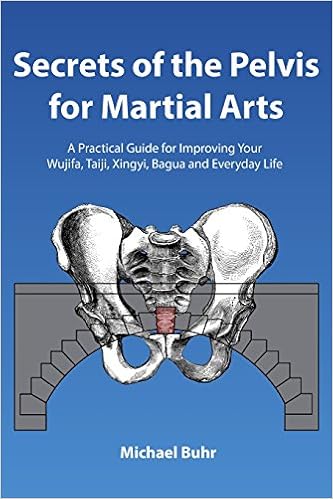
Secrets of the Pelvis for Martial Arts - New Book


My first book is now available both in paperback and as a Kindle e-book at Amazon.com. "Secrets of the Pelvis for Martial Arts: A Practical Guide for Improving Your Wujifa, Taiji, Xingyi, Bagua and Everyday Life".

The e-book came out first in March 2013. In response to requests for a paper copy, I then released a paperback version in December 2013. With the paper version I also enhanced the quality of the cover design for both books based on the original e-book design.

Since you can read the description and customer reviews at Amazon, here's a little about how this book came to be.

My two most popular blog posts have been Rounding the Crotch (圆裆) for Tai Chi and Zhan Zhuang and Relaxing the Pelvic Floor for Tai Chi and Zhan Zhuang. Due to this popularity and relationship of content, my Wujifa instructor suggested I combine these into a single e-book. That was back in February 2011. At that time, I just didn't feel like I had the level of skill and understanding to write what I would consider a quality book, a product that I would be proud of. Also, I just couldn't get my head around the whole e-book concept. I guess was pretty "old-school" then. But I'm learning...

Two years later... The actual research and writing took only the first few months of 2013. In the process of combining these two blog posts, and wanting to write a real book, I kept adding and adding and editing and re-arranging until one of those "a-ha" Zen moments hit and the current structure revealed itself. I knew then that this was the book! After that it was all about filling in gaps, doing translations, imposing on the generosity of friends and family to read almost-final drafts, and then more editing from their suggestions. The cover design was inspired by content I discovered in my research. A Photoshop expert helped me get it "just so". (She also helped me again with the enhanced version for the paper book.)

I put more work into this book than I put into my blog posts. So if you enjoy this blog, you're sure to be ecstatic over this book! There's a ton more information in Secrets of the Pelvis for Martial Arts that does not appear anywhere else in the blog! I'm really excited about this publication because I think it can be a real contribution to martial arts practitioners in general and internal martial arts practitioners in particular. Enjoy! Be sure to let me know what you think! Either comment here, or leave a review at Amazon or email me.


A January 2015 addendum...
It's now been almost two years since the e-book was released and just over year since the paperback was released. Even though the reviews on Amazon are overwhelmingly favorable, I appreciate the constructive critiques which I summarize as:
  • This book is just a collection of links (and links can go bad).
  • Although the topic is well-researched, it reads as if it were released prematurely.
To the first point, my original vision for this work was an interactive e-book. At that writing, I did not foresee a demand for a printed book. My bad.

To the second point, I am certainly taking these critiques under advisement for my next work and for an updated second edition of Secrets of the Pelvis.

A May 2020 addendum
I reviewed all links and made corrections in the e-book version. You can see these updates at: Secrets of the Pelvis for Martial Arts - Link Updates.


Wednesday, December 19, 2012

Internal Martial Arts as a Foreign Language

Learning the internal strength component of the internal martial arts is like a native speaker of English learning a foreign language like Chinese. Insofar as Chinese is linguistically different from English, so too is the quality of moving with internal strength different from our normal way of moving.

Framing the learning of internal strength in terms of learning a foreign language might be a useful model to help you gauge if you are learning a completely different body-movement language or if you are learning variations or refinements of your current body-movement language.

Let's first consider this basic sequence of language learning and cross-cultural experiences. Many of you may have walked part of all of this road in your life:
  1. If you never met a Chinese person and all you knew was based on what you heard, read, or saw on TV, then your meaning of "Chinese are X" would represent this level of understanding and experience.

  2. If you got to know a Chinese person as an acquaintance, friend, or in-law and learned to speak a few words in Chinese, for example, ni-hao, xie-xie, gam-bei, then your meaning of, "Chinese are X" would be different than before.

  3. If you took a 10 hour Chinese language class at the Community Education program and went on a ten day tour of China, then your meaning of, "Chinese are X" would be different than before.

  4. If you took a couple years of Chinese language at university, got a job in China and lived there for a year or longer, then your meaning of, "Chinese are X" would be different than before

  5. If you continued your Chinese language studies in China (in Chinese), developed complete fluency in Chinese, married a Chinese and lived within the wider Chinese community for 10, 20, or more years, then your meaning of, "Chinese are X" would be different than before.

Anthropologists and linguists have long argued over the relationships between language, thought, and culture. The way you "naturally" move is also as much a product of your native culture as is the way you "naturally" speak. Hence why this model fits so well here.

As we move through each of these five language-learning and acculturation "levels" we probably find the most people with a "Level 1" understanding and the fewest people with a "Level 5" understanding. The same is true in the internal martial arts community. Here's why.

Assume that your native body-movement language is "English" and the foreign body-movement language you want to learn is "Chinese". Remember, English, Spanish, French, and German languages are all based on or derived from the same Latin alphabet. Chinese is not.

So you come to your first Tai-chi Chuan class only knowing "English". (We'll use Tai-chi because it's the most well-known of the internal martial arts.) You learn open hand and weapons forms. Have you learned "Chinese"? No. You only learned "Spanish". You learned a variant language using your underlying "Latin alphabet".

You go on to learn Tai-chi push-hands. Have you learned "Chinese"? No. You only learned "French". You learned a variant language using your underlying "Latin alphabet".

You go on to learn Tai-chi joint locking and sparring. Have you learned "Chinese"? No.You only learned "German". You learned a variant language using your underlying "Latin alphabet".

From your "English" point of view, you think you are learning something completely different, and developing internal strength, however, the "foreign language" you are learning is merely a variant of a common underlying alphabet. An "M" is still an "M" and a "P" is still a "P". You are merely training a variant of your native body-movement language.

So how do you know when you are beginning to learn "Chinese"; a non-"Latin" body-movement language? You will know when your teacher begins teaching you 放松 and you ask if this is like "M" and your teacher says, "No"! Or your teacher begins teaching you 圆软 and you try to make it work like "P" and your teacher says, "That's wrong." Or you ask your teacher to show you 沉 and you have no letters to equate it to.

When you finally reach the understanding that there is no relation between 放松 and "M" or between 圆软 and "P" or between 沉 and any other "Latin" letter, and you can demonstrate a little 放松 and 圆软 and 沉 then you've advanced to Level 2 as above.

Just as many Americans experience culture shock when they travel to and are immersed in Chinese culture (and vice versa), when you try to make your "P" fit into 放松 or or "M" fit into 圆 or vice versa, you will probably encounter a kind of body-language culture-shock. More on this later.

See Part II: Internal Martial Arts as a Foreign Culture 

See also: How Beliefs Can Inhibit Martial Art Skill Development.
And: The Language of Internal Strength

Monday, December 17, 2012

Habits, Patterns, Blockages: Journal Notes #108

Notes from my November 2012 Zhan Zhuang Training Journal. I train with The School of Cultivation and Practice which practices Wujifa zhan zhuang. (My current reflections are added in italics.)

* Note for November, I'm still not fully back to practicing my Wujifa zhan zhuang training on a daily basis. I am doing some stance maybe 2-3 times a week for 10-20 minutes a session. However, I am doing the Wujifa adjunctive exercises and my Tai-chi form every day.

* Instructor's question to me: Why do you come to class? You're not training. You're not following through on breakthroughs you make. Why do you keep coming to class?
My answer: I don't know. Habit I guess.

Instructor: What if I told you that you couldn't come back?

Me: I don't know.

Instructor: What do you mean you don't know? I can see the expression on you face. What are you feeling?

Me: I would be sad... There must be something I'm not noticing.

Instructor: That's why you get stuck. There are things you're not noticing. How can you notice more of the things you're not noticing? Like when you said you'd be sad but that didn't come out as a response the first time.

* When you're discombobulated, confused, uncertain, that's when you're in a position to discover something. If you're in your patterns, then you're not in a position to discover anything.

* Question: Am I doing the rubberband hands exercise with more connection and movement through my upper chest? I've been practicing this the last couple weeks.
Answer: You are still using too much trapezoid and rhomboid. You need to relax more and find out how the breath moves the shoulder. If you let the shrimp move, you'll discover connection.

There are many shrimp in your body. When you feel the Wujifa shrimp, then that will help you. You have shrimp in the shoulder, neck, sternum, and kua. You have many shrimp. Don't limit yourself. Learn how the many become one.

* Question: What are you talking about, "shrimp"? What do you mean by "Wujifa shrimp"?
Answer: Here's a whole body movement exercise. You can see a similar whole-body movement in the Zebra and Mantis Shrimp when they are escaping danger.

* Fa-jing is simply an umbrella term for the quick release of stored energy. There are different ways to do this once you figure out how to move internally.

* One blockage to progressing is being afraid to really get it and become part of that small minority who really got it, who became great; being afraid of putting yourself out-there, becoming "public", taking challenges, taking "the heat".

* You must be able to move, that is, not move in a manner you've grown accustom to and as you normally identify as moving. There is another quality of movement which when done, looks like sheets of theraband pulling and stretching under the skin.

* Don't tuck! Use a different focal point to get "tuck". Push in under xyphoid process on the inhale. This creates feeling of rolling the dan-tian, belly up which creates tuck without tension. Then on the exhale, roll the belly out, down, and forward which "untucks".

* Notice your level of your functionality. If you can see the bigger picture, you can see the level of dysfunction you have. Once it is exposed, then you see the problem and what you have to work on.

* (Victor Chao made a guest appearance at the November 25th class. Here is what I consider to be the key points):
  • We practiced a method that he's currently teaching to help develop "sinking" which involved dropping the weight to the front of the "Bubbling Well" point rather than into the heel.
  • He too noticed that I'm holding in my chest; not letting go and dropping enough. Rick suggested I get Rolfed on my rib heads to help free up that part.
  • Victor read my pulse (Traditional Chinese Medicine style) and said: Strong Qi. Weak heart.
  • We then talked about "Qi flow" and arrived at an understanding that "Qi flowing" has a particular meaning in the internal martial arts which is distinct from all other definitions and uses of "Qi". In the internal martial arts, "Qi flowing" is a short-hand, abbreviated way to say the bones and connective tissue are correctly aligned which allows a particular body quality to show up. (In Wujifa we call this quality, "connection".) "Qi not flowing" means the opposite, that something in the alignment is wrong. There's muscular tension or fascial adhesion which is skewing the skeletal alignment; no connection.
  • Keep the abdomen and butt relaxed. These muscles are very strong but what you rely on for muscular strength will prevent or inhibit internal development.
  • Need to develop and use muscles of the inner side of the thighs; muscles that you normally don't use. These are the muscles used to develop fa-jing.
  • Must practice many times throughout the day even if only a few minutes. Need to develop muscle memory. If you're only practicing once or twice a day, you'll never get there because what you're not practicing is what you are practicing. Whatever you habitually do is either building or reinforcing muscle memory. (Sitting behind a desk, steering wheel, lunch table, sofa, etc. 10-12 hours a day outpaces 1-2 hours of practice.)
  • "Dragon Waves Tail" in BaGua refers to moving the tailbone. The tailbone has to move for fa-jing to occur. If you practice stance and your tailbone doesn't move, then this is practicing the wrong way. Need to open and close with breathing. If not, then you are locking.
Further reading:
Introductory article explaining this "Journal Notes" series: Zhan Zhuang Training Journal
Previous article in this series: Back To Where I Was Six Months Ago: Journal Notes #107
Next article in this series: - Submitting to the Experience: Journal Notes #109

Tuesday, December 4, 2012

Basic Training for Silk Reeling and Taijiquan

For beginners, Chen Xiaowang's "The Five Levels of Taijiquan" can be a bit abstract. Here is a really nice article that explains clearly and in plain English the practices and the changes the body goes through in developing what I understand to be those First Level Taijiquan skills.

What was gratifying for me in reading this article was that I resonated with most of what he was describing. I attribute this to my Wujifa training experiences, many of which I've shared in this blog. That said, I still consider myself unable to demonstrate some of these higher-level, basic skills. I need to practice more.... much more!

Read the full article here: The Five Most Important Taijiquan Skills for Beginners
The Five Most Important Taijiquan Skills for Beginners
by Wang Hai Jun and translated by Nick Gudge (2010)
Many people spend years studying taijiquan but for most of them their progress is slow in gaining the skills of taijiquan. Part of this is probably insufficient practice, but a significant element is not understanding the basic skills that beginners are required to develop. It is not possible to start taijiquan training and learning at a high level. Using conventional learning as an analogy, it would be like trying to start at Phd. research Level. In reality, first there is primary education, then secondary education, then undergraduate study etc. This is equally true in taijiquan. Without a good mental and physical understanding of the basic skills that are at the foundation of taiji, high level taiji skills will not be developed. It is not magic, but the result of consistent and sufficient training in the correct manner.
When asked what I consider the five most important skills for a beginner student in taijiquan, I  listed them as:
  1. Fang Song – Loosen the body by relaxing the joints
  2. Peng Jing – an outward supportive strength, the basic skill of taiji
  3. Ding Jing – upright and straight
  4. Chen - rooted
  5. Chan Si Jing – Reeling Silk Skill
These five basic skills should be considered the early steps in taijiquan training. Without these basic skills being embedded in the body and the accompanying changes that occur during the process, a student is stuck outside of taijiquan. They are learnt through exercises and in the process of learning and training the foundation form of taijiquan.

Master Wang Hai-Jun was the first non- Chen family student to be traditionally trained in Chen Village in Henan in modern times. His teacher, Grandmaster Chen Zhenglei, is one of the "Four Golden Tigers" of Chen style Taiji. More information is available at Master Wang Hai-Jun's Chen Taiji Academy.

And if you haven't read Chen Xiao-wang's Five Levels of Taijiquan, you can find information about this at my article about The Five Levels of Taijiquan.