Monday, February 21, 2011

Still Confused About Feeling: Journal Notes #27

Notes from my May-June 2005 Zhan Zhuang Training Journal. I train with The School of Cultivation and Practice which practices Wujifa zhan zhuang. (My current reflections are added in italics.)

* Question to me: What do you want to get out of class?
  1. Guidance.
  2. Encouragement.
  3. Learn some unexpected thing.
  4. Social time / camaraderie.
(I think this is another way of asking; What's your purpose for being here in class? Interestingly, I'd say the same thing if asked again today although, I'd be speaking from an entirely different space and the meaning behind the words has changed.
For example:
1. Guidance; Changed from "Teach me." to "Will how I am practicing result in the "mistake of inches" or am I on the right track?"
2. Encouragement; the form has changed. I'm finding more "self" encouragement in the feedback to my understanding and practice.
3. Learn something unexpected; changed from "You show or tell me something I haven't seen or heard before." to "I discover some new "a-ha" moment, though not so much on my own as is revealed in a response to a question."
4 . Camaraderie; This has pretty much stayed the same. We've got a good group and I enjoy training and hanging-out with them.)
* Experiment with practicing stance on a wobble board and then on wobble shoes.
(The School of Cultivation and Practice "dojo" is a very interesting place. There are a wide variety of physical therapy type items. I must have been playing around with the wobble board and asked about practicing stance on one of these. That said, I never did get a wobble board nor practice on one.)
* Side to side, the inguinal crease should be a feeling of folding in on itself.

* To get the feeling, don't just emotionlessly "go through the motions". One method is to activate anger, move with anger to get the whole body moving properly.
(I tend to squelch and not notice my emotion-feelings, that is, except for anger, so I think the idea here is that any feeling-emotion, even anger, is better than a feeling-less, Spock-like, mechanistic approach to training. Put some life into it! Advice I need to heed even now...)
* Again, in class, I'm receiving adjustments to my stance posture. I'm resisting following his prompts. And as he gets to a point as I'm standing on one leg, almost there and then the leg gives out and he says, "You had it just before you picked up and moved to the other leg." I think, "Had what?" Confused. Is the feeling of giving out or collapsing the feeling I'm striving for? I'm so clueless!

* Three ways to practice / develop / train:
  1. Tortoise - slow and steady, yield long healthy life but probably not mastery in one life time.
  2. Credit card - take short cuts, get what you want now but pay for it later.
  3. Hard work - like any sport, instrument, practicing four hours a day will get mastery in one lifetime.

(I think this must have been in response to "Isn't there a quicker way to get this?" In 2005, I'd been doing this Tai-chi thing for twenty years and was getting frustrated feeling like I wasn't getting any closer to "getting it". Am I wasting my time here too? etc.... )

* So many techniques are parlor tricks to "Wow!" the unknowing audience.

* When you write down your practice questions, often you wind up answering them yourself.

* Question: How to train the dan-tian area to start to develop the fa-jing of pole-shaking?
Answer: Continue standing. If you try to practice pole shaking without being firmly in your dan-tian, then you'll do it wrong.
(I've brought this question up in different forms over the years, and the answer is always the same; Continue standing. You are where you are. If you try to work at a higher level than where you are, you'll do it wrong and create bad habits. While this is not the answer I want to hear, I wish everyone were as lucky as me to have a teacher like this... who does not cater to my ego. I recall hearing Yang Jwing Ming once saying to always go back and practice the basics. Now I understand how doing so can deepen understanding and improve ability.)
* Question: Why can't I (and others here at school) hold ourselves up when through your adjustments, we achieve correct stance?
Answer: Not enough jing. Jing is not strong enough to support a correct structure.
(Note: Wujifa does not use the terms: chi, jing, shen, dan-tian. I'm guessing that my words were used in these answers because that is how I framed the question. I'm guessing that because of my Tai chi past, I must have used the term or brought up the "chi, jing, shen" thing and so for my note, I recorded the answer as seen here.)
Further reading:
Introductory article explaining this "Journal Notes" series: Zhan Zhuang Training Journal
Previous article in this series: Mechanistic or Organic: Journal Notes #26
Next article in this series: Yan Gaofei Tai-chi Spear Seminar: Journal Notes #28

Tuesday, February 15, 2011

Relaxing the Pelvic Floor for Tai Chi and Zhan Zhuang

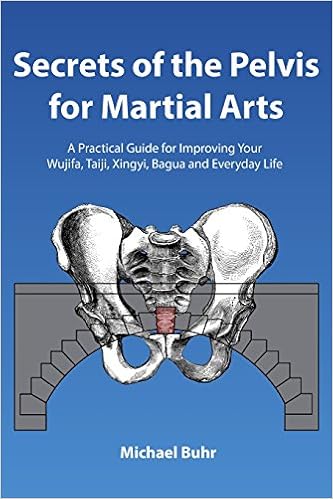
This article was originally posted on February 15, 2011. It was removed by me (the author) on March 26, 2013 because the content is now included in my new book, Secrets of the Pelvis for Martial Arts: A Practical Guide for Improving Your Wujifa,Taiji, Xingyi, Bagua and Everyday Life.

My apologies to those who have bookmarked this article for reference. It came down to a choice between keeping this article or publishing the book. If you are interested in the original article, you can search the Internet Archive.

If you don't have a Kindle or iPad, don't despair. You can find free Kindle reading apps for your PC, Mac, tablet and more at Amazon and read e-books on your computer.

For this new e-book, I began with combining two of my blog articles, this article and "Rounding the Crotch (圆裆) for Tai Chi and Zhan Zhuang." Both articles were greatly elaborated upon and expanded in this new book. The book also includes many more chapters and a ton more information that you won't find in this blog.

I hope you check out this book. You're sure to get a perspective on internal martial arts training that you won't get anywhere else!

The comments you see below are comments to the original article. While they don't make a lot of sense being now out of context, it's still nice to see that folks commented on this article.

Monday, February 14, 2011

Mechanistic or Organic: Journal Notes #26

Notes from my April 2005 Zhan Zhuang Training Journal. I train with The School of Cultivation and Practice which practices Wujifa zhan zhuang. My notes skip from February to April; no notes from March 2005. (My current reflections are added in italics.)

* The purpose of stance is to change the body. Three years for the legs and six months for the arms.
(And I will add, ...of diligent, correct practice under the guidance of someone who actually has third-party verified, demonstrable skill and is able to teach someone who is able and prepared to learn. So, yes, there are a lot of variables... I think you'd be fooling yourself thinking you could start from "scratch" and develop internal strength within three years practicing an hour a day learning from a self-proclaimed "master".)

* Armoring. If you respond to an assault and then release the response after the assault has passed, this is healthy. If the assault happens frequently (or is perceived to) and you decide to make the response permanent, then this becomes armor and is not healthy. Armor is not instilled by others but by me. It's my response to others.

* In "The Mass Psychology of Fascism", Reich talks about life in the most straight forward, layman accessible language: mechanistic and authoritarian life has created a rigid body that is out of touch with and not feeling its own bio-organic core. So I ask...

* Question: What's the difference between mechanistic and organic? (The set-up for the explanation and answer is a chair and a few feet away is a table with a glass of water on it.)

Example A: Sit in that chair. Get the glass of water. (OK, task done.)

Example B: Sit in that chair. Now, before getting up out of the chair, think about getting up with the intention of going to get a glass of water. Think about what how it feels, how the body responds. Now, only stand up but with the intention of going to get a glass of water. Check-in with your body. How are you feeling? Now reach for the glass. Don't touch it yet. How does this feel? Now, pick up the glass. Check-in. Feel the glass in your hand. (A completely different experience!)

* Answer: Example "A" was done mechanistically, automatically, like you've done hundreds of times before. No thinking. No feeling. No presence. Example "B" was done organically with mindfulness, purposely, noticing and feeling at each "step".

* Do everything organically starting with stance. Don't just mechanistically start stance thinking about all the parts lining up, dropping, etc... First, while sitting, check-in with yourself, feel, say, "I'm going to do stance now." Before getting up, feel yourself doing stance. Check-in often. Move purposely to your location. Then begin practicing stance.

(Despite all the feeling work I've done, I would say that I'm still largely in the mechanistic camp though the organic camp has developed enough to create some tension between the two. I'm still not willing to let go of old, mechanistic habits. For example, I approach stance mechanistically and while in stance, practice feeling; nibbling on the crust of the "organic" pie. )
* Formulating questions for class forces us to examine our practice and to be curious and to look for experiences we don't understand and try to answer for ourselves.
(I've heard this so many times over the years and I still resist or neglect taking full responsibility for my own development. Sure, I mechanistically and dutifully bring questions to class, conforming to the Wujifa school "rules" and yes, doing so has shifted or nudged me slightly in the direction of being responsible, but yet, my "transitional approach" is just another kind of "spoon feeding". That said, the deeper I get into this practice, the better I understand that the only way to "get it" is to really apply myself to figuring this out for myself.)

* Must stand everyday even if tired. If tired, then just stand tired and don't do anything. Just stand. Missing one day of stance puts you back three days.

* Watch the movie, "The Matrix".

* Question: Am I rotating the hips correctly in this exercise? Is the feeling I feel of open and close on the right track?
Answer: You're still too wobbly, noodley on top. You need to work out the wobble.

(The above note is referring a Wujifa exercise to help develop a feel for the fascial stretch from head to foot. In my case, the bad habit I was working on (and is still in me though now to a lesser degree) is from the noodle-man style of Tai chi push hands I embodied in my earlier training.)

* Question: At the last class, you noticed I was still holding too much in the chest/upper back and only dropping from the waist down. I've worked on dropping the upper body. How does this look?
Answer: Still not getting into the legs. (Then I received adjustments.) Same feeling as previous sessions. Legs give out. Muscle not strong enough. You need to practice sitting on a stool and lifting off, dropping, sitting, lifting. Do this a hundred times a day.

* The patella (knee cap) is not attached to the femur so the direction the knee cap points is not necessarily an indication of the turning of the femur.

* If you feel a problem in the knee, then the problem could be in the hip. Correct the hip and see if the knee problem goes away.

* Question: Why do I feel pain in my knees when I do stance?
Answer: Because you're only dropping from the waist down and you're holding on top. You need to drop everything. It's a whole-body movement.

* The purpose of training methods is to elicit a particular feeling, to give you a "feel" for something.

* Question: Is "bowing" a correction of leaning back?
Answer: Yes. Sometimes though it is incorrect. It is a method to get the feeling of the inguinal crease.

* The method is not the truth. Once you get the feeling, get rid of the method.

Further reading:
Introductory article explaining this "Journal Notes" series: Zhan Zhuang Training Journal
Previous article in this series: More Pelvic Work: Journal Notes #25
Next article in this series: Still Confused About Feeling: Journal Notes #27

Tuesday, February 8, 2011

Rounding the Crotch (圆裆) for Tai Chi and Zhan Zhuang

This article was originally posted on February 8, 2011 It was removed by me (the author) on March 26, 2013 because the content is now included in my new book, Secrets of the Pelvis for Martial Arts: A Practical Guide for Improving Your Wujifa, Taiji, Xingyi, Bagua and Everyday Life.

My apologies to those who have bookmarked this article for reference. It came down to a choice between keeping this article or publishing the book. If you are interested in the original article, you can search the Internet Archive.

If you don't have a Kindle or iPad, don't despair. You can find free Kindle reading apps for your PC, Mac, tablet and more at Amazon and read e-books on your computer.

For this new e-book, I began with combining two of my blog articles, this article and "Relaxing the Pelvic Floor for Tai Chi and Zhan Zhuang". Both articles were greatly elaborated upon and expanded in this new e-book. The book also includes many more chapters and a ton more information that you won't find in this blog.

I hope you check out this book. You're sure to get a perspective on internal martial arts training that you won't get anywhere else!

The comments you see below are comments to the original article. While they don't make a lot of sense being now out of context, it's still nice to see that folks commented on this article.

Monday, February 7, 2011

More Pelvic Work: Journal Notes #25

Notes from my February 2005 Zhan Zhuang Training Journal. I train with The School of Cultivation and Practice which practices Wujifa zhan zhuang. (My current reflections are added in italics.)

These are notes from talking with my Rolfer:

* Began the first set of three advanced Rolfing sessions after about a year from when I finished the initial ten sessions.

* Observation, as he (the Rolfer) was working, he asked "What do you feel there?" My response was "Nothing". I think how sad is this culture and language that is so divorced from the body. Where's the language to express feelings of the body, not only emotional feelings but also somatic feelings? It seems there's a whole vocabulary missing...

* The way we hold ourselves, hold muscular tension, hold fascial adhesions becomes how we define ourselves, for example, this pattern of tension and adhesions is Mike. If we free the adhesions and release the tensions, then who we are also changes.

* If you can't feel your body, then what's the point of having a body?


These are notes from class and my own personal experience:

*Question: How do you get through or over barriers?
Answer: You can follow one of two methods: Love or Rules.

Love - Say I just love doing "x" and because I love it so much, I'm going to do it more and more.

Rules - Make a rule for yourself and then follow it and say "It is better to die than to break the rule." Adhere to the rule at all costs. This is the old Germanic way that so many of us live by and why so much fruit withers on the vine before harvest.

(My current zhan zhuang practice is somewhere between these two. I am curious and in the curiosity is a love. And on the other hand, I really don't look forward to the discomfort of "getting the burn" in my legs everyday and so the rule helps to keep me practicing. And in practicing, sometimes I discover a new feeling, which inspires me to practice more...)
*Question: Is it OK to practice stance while using a pelvic floor relaxation method?
Answer: If it helps reduce the clenching, then yes. The reason is to relax.

* I had the experience of practicing stance while using a pelvic floor relaxation method and was comfortable. Then, two people in the next room started arguing and quickly this method became very uncomfortable and then unbearable and I ended the training session. This was a good learning experience for me; I felt the muscles of the pelvic floor tighten in response to an emotional reaction. A very good lesson!

* Even though this pelvic floor relaxation method has reduced muscular tension, I still need to bring attention into the front of the lower pelvis to get that "ka-chunk" dropping feeling; the feeling of the whole lower pelvis swelling and expanding.

* Remember, all the points are components of a feeling. Get the feeling. Move from focusing on the components to what the components add up to.

* I'm noticing more and more how the body is connected. Clench the anus and the jaw tightens. Tighten the fist and the jaw and anus tighten.

(This is another example of the saying: When one part moves, all parts move.)
* Our body patterns first get stuck when we first learn to walk. We keep and "enhance" that pattern throughout life.

* The body resists change even though it knows that change is beneficial. This is the power of habit and culture.

* I attained a further level of relaxation practicing a pelvic floor relaxation method. The next day I fell ill with a 104 degree fever and chest infection.

(Sometimes there is a relation between releasing chronic tension and some observable manifestion and sometimes there is not. In any case, as I learned in class, it's probably best to say, "That's interesting." and continue the work of relaxing.)
Further reading:
Introductory article explaining this "Journal Notes" series: Zhan Zhuang Training Journal
Previous article in this series: The Zhan Zhuang Recipe: Journal Notes #24
Next article in this series: Mechanistic or Organic: Journal Notes #26