Showing posts with label Training Tips. Show all posts

Tuesday, December 13, 2011

New Insights on Old Zhan Zhuang Video

Occasionally I like to re-watch old movies and videos. I'm often surprised with new insights. I recently re-watched Erle Montaigue's Advanced Qiqong Volume 2 (MTG 175) and discovered that I now understand what he was saying about zhan zhuang entirely differently than I did when I first watched it about ten years ago.

Advanced Qiqong Volume 2 discusses Three Circle Qi Gong or what looks like Zhan Zhuang. Here is a short clip:


This time around, I noticed that:

Relaxing Feels Like

He speaks of the feeling of relaxing/dropping as "feeling like" a chain dropping in a tube. Ten years ago, I tried imagining this image happening in my body to force the "like" feeling but I couldn't make it happen. Today, I relax into my legs and I understand that, yes, relaxing with Wujifa zhan zhuang structure could be described as feeling like a chain dropping in a tube. Lesson learned: Trying to force someone else' "feels like" feeling will not result in the feeling they say it "feels like". Practicing relaxing results in a feeling that may be described as...

Zhan Zhuang Isn't Boring

He mentions that if you're bored with Zhan Zhuang, then you're not doing it correctly. Ten years ago, I didn't understand zhan zhuang and found it boring! I only wanted to practice push-hands and light sparring to maintain my skill level. Today, with a calmer mind and more body focus and presence, and a kind of re-direction of purpose, I've discovered that zhan zhuang is definitely not boring! Difficult and challenging, yes, but not boring. Lesson learned: Getting clear on my purpose and finding the appropriate training method makes a huge difference.

Super Qi Powers

He mentions that people give up because they're looking for all the wrong things. Ten years ago, I was looking to develop super Qi powers through stance. Today, I'm finding more by not looking for anything in particular but by simply noticing what's there. Lesson learned: I gain more when I practice the ordinary until it becomes extra-ordinary than practicing some special, advanced Qi-gong that my body is not yet ready to enjoy the benefits of. (See: Ordinary and Extra Ordinary: A Secret of Wujifa Training.)

Activate Acupuncture Points

He talks about feeling the acupuncture points activating. Ten years ago, I wondered how he felt individual acupuncture points "activate" (What does an inactive acupuncture point feel like in comparison?) and I imagined activating my acupuncture points. Today, I still can't feel specific acupuncture points and I really don't care. I feel what I feel and I notice what I notice. I am where I am and that's where I start. Lesson learned: Words are too ambiguous. Show me the feeling in my body that you are talking about. Give me a simple exercise designed for my level to help me change and grow.

Relax and Widen Pelvis

He talks about feeling the pelvis relaxing and the lower back widening. Ten years ago, I could feel this and thought I knew exactly what he meant. Today, I feel sooooo much more and I wonder how much further this can go. Lesson learned: There is no end to feeling, understanding and being aware. The only goal is the point I achieve when I quit training.

Tension Held in Chest

He talks about tension and holding up. Ten years ago, I was so full of tension and holding and I didn't have an experience of drop and let go to compare to tension and holding up. I had only a conceptual understanding and no body-experience understanding. Today, having experienced the feeling of dropping into my legs and what it took to get there. I understand much more about tension and holding up. Lesson learned: It takes a lot of correct practice to get to the point of body-understanding. Reading or hearing "x" and literally thinking "I understand" is the wrong path. Practice, demonstrate, validate.

Forcefully "Allowing"

He talks about letting happen what will naturally happen and don't try to imitate or force the shaking. Ten years ago, I very well may have forcefully "allowed" the shaking because that is what's "suppose" to happen. Today, I have experienced how the shaking arises and diminishes naturally and I notice spots where I tend to block it and when I relax more then... Lesson learned: This is coming around to teach me again. In my recent Wujifa class I tried forcing the feeling of fascial connection. Of course, I was justly reprimanded. Too much muscle! Relax more. There! That's it!

Stand and Breathe

He talks about just stand and breath. Let the body do what it does. Ten years ago, this was a confusing "huh?" concept. But... But... But... Today, I am discovering what this means. Lesson learned: The highest level practices when stated simply confounds the mind. Stand and relax. Can you do it? Further reading: See my earlier blog post titled: Notice Differently where I re-read The Way of the Peaceful Warrior by Dan Milman and noticed passages that related to experiences I've had since reading it the first time.

What new insights have you had on old teachings, books, videos? How has your understanding changed as your practice has evolved?

Thursday, May 5, 2011

Yan Gaofei Xing-Yi Basics Seminar 2006

Notes from the April 22-23, 2006 Yan, Gaofei seminar held at Plymouth, Michigan, USA. The seminar covered the Xing-Yi training and philosophy. This seminar was organized by The School of Cultivation and Practice. If you're new to this series, check out my introductory article, Zhan Zhuang Training Journal. (My current reflections are added in italics.)

Some Background
* Chinese are great observers. They noted the cycle of creation and destruction are balanced. The minimum number of elements in this cycle is five. So the Five Elements shows how the Chinese think in terms of the big picture and in terms of influences.

* Xing-yi focus is only on straight ahead, what is "in the alley". If attacked from side, then change position to face attacker so s/he is in "the alley".

* Xing-yi was developed from spear.

* All martial arts originated with elbows down. Only in competition were elbows raised because it looked fancier. Unfortunately, the elbows down has been lost in many forms.

* Here's how to check if your arm and elbow position is correct. Stop at any point and hold a ten pound weight. If you can hold it five minutes and shoulder muscles don't get sore, then position is correct. Keep elbows down!

* Logic of American boxing relies on muscular speed and not internal structure. Xing-yi relies on internal structure. Logic of Chinese internal arts:
  • Xing-yi: I move into your center.
  • Ba-gua: I move around your center.
  • Tai-chi: I am the center.
* In application, all three could be applied seamlessly in one exchange.

* Six Harmonies means internal connectedness. It does not mean a puppet-like "coordination", which is how this is often misinterpreted.
  • Shoulder and Kua
  • Knee and Elbow
  • Foot and Hand
* In Tai-chi it is said, "Rooted in the feet. Directed by the waist. Expressed in the fingers." The Six Harmonies is how to do that.

* It's better to train only one move and be able to do that instinctively than it is to train 200 moves and get stuck (even a split second delay) on "thinking" which move is the best in that situation.

* Xing-yi is the simplest of all the internal martial arts and hence the most effective art.

Xing-Yi Legs and Kua* Stepping - Back foot at 45. Front foot straight. Heels on same line. Max power and stability on a line in "the alley". 70% in back leg. Shift briefly to front then finish into back leg.

* Kua - 80% of the "secret" of internal martial arts is in the kua.

* Inside of thighs must form an arch, not a triangle.

* You get the arch by rotating the top of the femur (greater trochanter) forward.

* Don't force it. Relaxing the top will naturally create the desired result. It's like the top is a screwdriver and the bottom is the screw. Relaxing opens the kua.

* Each art has its own way to describe correct kua movement; folding, rolling.

rounding the crotch and stepping

Xing-Yi Torso and Squatting Monkey
* Waist is the central pivot. As punching hand moves forward, pulling arm moves backward.

* Practice the "Squatting Monkey" exercise contract and squeeze. Contract as forearms and hands pass each other. Expand as if stretching, tearing something as punching hand extends and pulling hand retracts. Keep chest relaxed with expand.

* Upon contact with opponent, first move with squatting monkey is contracting to draw in opponent.

squatting monkey exercise

A rare video showing squatting monkey (Dai Xinyi) though not from this seminar:


Xing-Yi Arms* In Xing-yi there are basically two arm moves:
  1. The pulling hand. Imagine pulling a rope attached to a wall and pulling the wall down. In application, intercept the incoming fist with palm up, turn over, grab, and pull opponent.
  2. The punching hand.
xing yi arms
* Punching hand movements:
  • Water - Up the center then out.
  • Steel - Chop like an axe.
  • Wood - Straight out, drilling, fist knuckle out.
  • Fire - Pulling hand moves up and back. Punch straight in.
  • Earth - Angle step. Only Earth finishes with weight in front leg.
* Fire is not two vectors, rather just one circular vector.

Practice Engaging
* Practice engaging your opponent. If you only practice forms and you never practice engaging, then your practice lacks applicability. How to engage your opponent is key!

* Begin practice with a helper using a straight in punch. Practice with opposite hands, then with same side hands.

* The principle in all moves is upon contact, to immediately drop/sink, cover your center, turn, squeeze. This pulls opponent out of back heel and sets opponent up to fall into your oncoming fist effectively increasing your striking power by using gravity against him/her.

* First half of form (pulling) is to destabilize your opponent. The second half (continue pulling and punch) is to split/tear/rip your opponent.

* Consider how gravity can be used against your opponent. How your opponent's weight in gravity becomes the real enemy.

* Logic of two man form is as soon as you feel the force taking you off balance, then start the next move.

Wednesday, April 20, 2011

Top Ten Internal Martial Arts Training Mistakes

Over my nearly thirty years of training the internal martial art of Tai-chi Chuan, I have made a lot of mistakes in my pursuit of internal strength. Here are my top ten training mistakes. Some of these may sound obvious and others may sound controversial. Hopefully, any one of these will prevent you from falling into the same trap.

1. Not knowing your purpose; not knowing why and what you are training.
I've learned that purpose defines what is and is not "in scope" and helps clarify what questions get asked, like, "So how exactly does this exercise help develop the feeling of internal strength?" and my all time favorite, "How do you know?"
Tip: Know what you want and why you are training what you are training.
2. Not knowing the "connectedness" feeling of internal strength.
When I didn't know the feeling of internal strength, I didn't know what it was I wanted to develop. I believed whatever I was told it was. Some teachers teach mechanics and technique and call this "internal strength" but it is not.
Tip: Do your research. Get a sense of the feeling before committing to a training program.
3. Believing that practicing forms for years will lead to internal strength.
I discovered that forms are too complex to figure out the subtle feelings that are only revealed while standing still or while practicing simple, repetitious patterns like side-to-side.
Tip: Stop practicing forms and only practice zhan zhuang and simple, repetitious patterns like side-to-side.
4. Choosing a teacher based on a well known and respected lineage.
In my experience, the lineage of a teacher is not evidence in and of itself that that teacher actually has any internal strength skills.
Tip: Touch hands with the teacher's students and feel if anyone has skill. Sometimes the "rogue" teacher without a lineage may also have internal skills.
5. Thinking that a Tai-chi, Ba-gua, Xing-yi, Yi-chuan teacher has internal strength skills just because the teacher looks and sounds Chinese.
I've come to learn that a teacher's "Chinese-ness" is no guarantee of possessing internal skills and a teacher lacking "Chinese-ness" should not be dismissed as not having internal skills.
Tip: Don't judge a book by its cover.
6. Not validating my skill with others outside my school or training program.
I used to think that I was making progress when in fact I wasn't, and I didn't even know that I wasn't.
Tip: Find someone outside your school to validate or verify your experience.
I don't mean challenges or competitions. A minute of simple, static point-to-point "push hands" is sufficient to get valuable feedback.
7. Believing I need to train in China to get quality internal skills training.
I think this was more true thirty years ago than it is today. There are now more quality teachers available outside of China than ever before.
Tip: The grass is not always greener on the other side. Discover who is in or traveling to your area or country.
8. Believing that I need to learn Chinese language, culture and philosophy, Chinese Traditional Medicine, the Tai-chi Classics, Qi-gong or any other "energy" or "spiritual" or "Taoist" practice to develop internal strength.
I learned so much of this stuff over the years and NONE OF IT contributed to my developing internal strength.
Tip: A good teacher should be able to show you with several quick postural adjustments how to
elicit "the feeling" in your own body as well as discern "the feeling" in others. If your teacher can't guide you using your local vernacular (in "plain English" for my U.S. readers), then look for another teacher.
9. Thinking that there is only one "style" of zhan zhuang.
The more I practice Wujifa zhan zhuang and the more I view (on-line) how others teach and practice (and see their results), the more I see and understand that practicing zhan zhuang in and of itself may not necessarily lead to internal strength.
Tip:
Either find a teacher who has internal skills who can guide your zhan zhuang practice and/or seek out true masters from whom you can receive guidance.
10. Believing that internal strength is a physical skill (like learning basketball) that I could add onto my existing structure or way without fundamentally changing who I am.
It's taken me a long time to experience that developing internal strength is about changing my body, body-mind, soma-psychology, neural pathways or whatever you call it, by inviting me to "let go of" and not "add on to".
Tip: Sorry, no tips on this one. I too struggle with letting go of deeper ingrained habitual holding patterns that I'm afraid to let go of.


I'd like to hear from you. What's on your Top Ten List of Internal Martial Arts Training Mistakes? Have you made any of these mistakes in your pursuit of internal strength? From your experience, have you reached the same conclusions or a different conclusion?

Wednesday, April 6, 2011

Beginner's Mind: The Zen of Internal Martial Arts

Much has been written about the "Beginner's Mind" both in Zen (or in Chinese: 禅;chán) meditation practice and its interwoven history with the internal martial arts: Tai Chi, Ba-gua, and Xing-yi chuan. This article suggests one way to refresh the Beginner's Mind when it doesn't feel like a beginner anymore.

In Discover Your Power: Journal Notes #33, I mused over whether I would ever be able to develop the internal strength or effortless power that made famous Tai Chi, Ba-gua, and Xing-yi chuan. Shortly after posting that article, my elder school brother talked to me and I'd like to share our conversation.

Developing internal strength or effortless power should probably take about three years of diligent and correct practice to bring someone "through the door"; to change the mind-body sufficiently to elicit the kinesthetic experience upon which internal strength or effortless power may develop.

Yet, in my case, I've been chasing this butterfly for twenty-five years and practicing stance for over ten years and have been brought "through the door" on multiple occasions by a very dedicated teacher and friend, and yet I still cannot demonstrate the kinesthetic quality of internal strength or effortless power. Why not?

My pattern, as observed by my instructor was not apparent to me until he pointed it out to me; every time I get close, every time he takes me through the door, my response is to either literally run away (see my Three Years Away: Journal Notes #11) or to withdraw or shut down. There are a wide and probably endless variety of reasons or excuses. And even though I have noticed this pattern in others (it must be a typical pattern), I could not see it in myself. Interesting, eh?

Question: So how do I recognize what pulls me away before it pulls me away?
Answer: That is not the correct question. It is better to ask: How do I keep it going?

As I blog my Zhan Zhuang Training Journal, I notice that my notes, the data I've gathered are mostly class notes and not primarily a daily training diary or journal. Data is my strength but I'm not using my strength to my advantage in this project.

Here is a suggestion to begin a new way to practice. Write a real training journal. Begin each morning with an "Intention for the day" and how I intend to achieve it. Intention and action plan. Then practice. Immediately after practice then write down your experiences and any questions or observations that came up during practice.

Collect your own data. Analyze your own data. Reach conclusions about your own data. Pose questions to yourself based on your own data. Make training decisions based on your own data.

Set the intention. Make a choice. Act on it. See it through. Take a Project Management approach to developing internal strength.

What do you want? Internal strength. Effortless power.
How do you develop that? Practice stance; Wujifa zhan zhuang.

I'll bet that many people come to the door of internal strength/effortless power and then walk away and look for another door (Oh no! Any door but that!) or they quit altogether and in both cases, never learn the real reason why. I've done this repeatedly.

It's easy to have the Zen-like beginner's mind, the unbridled enthusiasm, passion and openness when you have not yet encountered that which must change in yourself to "get it". I have run into my "demons" and have run away from them. Sometimes it is not pleasant to have a beginner's mind.

So how will this story end? It seems there are a few options:

1. Quit. Walk away for good. Be done with it forever.
2. Continue the same old approach and never really "get it".
3. Begin again but this time, take a different approach.

Bottom line, keep practicing...

Tuesday, February 15, 2011

Relaxing the Pelvic Floor for Tai Chi and Zhan Zhuang

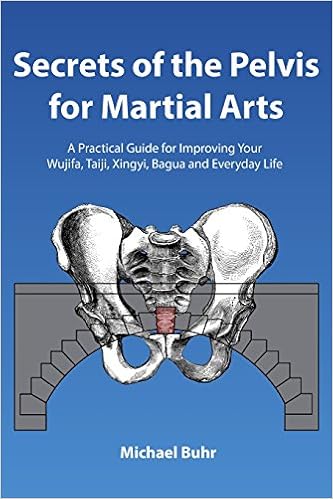
This article was originally posted on February 15, 2011. It was removed by me (the author) on March 26, 2013 because the content is now included in my new book, Secrets of the Pelvis for Martial Arts: A Practical Guide for Improving Your Wujifa,Taiji, Xingyi, Bagua and Everyday Life.

My apologies to those who have bookmarked this article for reference. It came down to a choice between keeping this article or publishing the book. If you are interested in the original article, you can search the Internet Archive.

If you don't have a Kindle or iPad, don't despair. You can find free Kindle reading apps for your PC, Mac, tablet and more at Amazon and read e-books on your computer.

For this new e-book, I began with combining two of my blog articles, this article and "Rounding the Crotch (圆裆) for Tai Chi and Zhan Zhuang." Both articles were greatly elaborated upon and expanded in this new book. The book also includes many more chapters and a ton more information that you won't find in this blog.

I hope you check out this book. You're sure to get a perspective on internal martial arts training that you won't get anywhere else!

The comments you see below are comments to the original article. While they don't make a lot of sense being now out of context, it's still nice to see that folks commented on this article.

Tuesday, February 8, 2011

Rounding the Crotch (圆裆) for Tai Chi and Zhan Zhuang

This article was originally posted on February 8, 2011 It was removed by me (the author) on March 26, 2013 because the content is now included in my new book, Secrets of the Pelvis for Martial Arts: A Practical Guide for Improving Your Wujifa, Taiji, Xingyi, Bagua and Everyday Life.

My apologies to those who have bookmarked this article for reference. It came down to a choice between keeping this article or publishing the book. If you are interested in the original article, you can search the Internet Archive.

If you don't have a Kindle or iPad, don't despair. You can find free Kindle reading apps for your PC, Mac, tablet and more at Amazon and read e-books on your computer.

For this new e-book, I began with combining two of my blog articles, this article and "Relaxing the Pelvic Floor for Tai Chi and Zhan Zhuang". Both articles were greatly elaborated upon and expanded in this new e-book. The book also includes many more chapters and a ton more information that you won't find in this blog.

I hope you check out this book. You're sure to get a perspective on internal martial arts training that you won't get anywhere else!

The comments you see below are comments to the original article. While they don't make a lot of sense being now out of context, it's still nice to see that folks commented on this article.

Tuesday, January 25, 2011

Guang Ping Tai Chi: Push Hands Forms

This is the forth and final part of a four part series presenting what I learned while briefly studying with Master Gary Torres from January to September 2000. Gary learned from Peter Kwok, the founder of Peter Kwok's Kung Fu Academy in the Guang Ping Yang Tai Chi lineage. Gary is the head of the Phoenix Dragon Kung Fu Academy.
__________

In popular Tai chi, push hands training takes many different forms. When I studied with Gary Torres who taught from the Guang Ping Yang system, I learned not only push hands sets but also the martial aspects of these forms.

* There are many forms and techniques. Like many branches, all emanate from the same trunk. Don't just look at a form or technique and say "Wow! I never saw that before!" and be amazed. Rather, look for the underlying principle. All forms and techniques are based on principle. When you understand the principle, meaning, when you can manifest the principle and not just intellectually explain it, then the multiple forms and the 10,000 techniques will readily come out. It's like doing math. You might know that 2 + 2 = 4 but if you don't understand the principle, then you can't do 1 + 3.

(I think this above note is from outside of Gary's class but is in the Gary notebook. It's a good note, so I included it here.)
* Tai chi as a martial art is based on Yin-Yang; soft and hard. The defender should feel (to the attacker) like what is in an empty bucket; nothing. On attack, the attack should feel like a pipe wrench hitting concrete; hard. Nothing and extreme hardness, this is how tai-chi works.

* "Uprooting" simply means getting the opponent to out of their "root", to lose balance in any direction with either pushing or pulling.

* For every Chin-na application there is a reversal. Must learn both because you must know how to get out of a Chin-na put on you.

nine directions of attack* There are only nine ways to attack and be attacked (another system says 13). This is the system of "nines". When you know these, then you learn which move best defends against each "mode" of attack. Tai-chi developed moves to not get hit by each one of these nine attacks and simultaneously attack the attacker. Learn the tai chi form with the end in mind.


* From defensive position, attacks will only come in nine ways, from your:
nine directions of defense


* Push hands
push hands force directionIncoming force can be directed up or down. Most push hands exercises only teach taking force to the left or right. This is too limiting. In truth, the incoming force can be directed in any of the 360 degrees.


* Four Patterns of Push Hands (推 手; tuī shǒu) :
1. Single or Simple Push Hands (单 推 手 ; dān tuī shǒu)
2. Paired or Double Push Hands (双 推 手 ; shuāng tuī shǒu)
2A. Little Pull Fixed Step (小 _ 定 步 ; xiǎo lu dìng bù)
2B. Little Pull Moving Step ( 小 _ _ 步 ; xiǎo lu huo bù)
* Four combinations of Single Push Hands. Each has a different feel. Learn these four feelings. Each has an advantage and disadvantage on defense. Play differently:
  • Left arm with left foot forward
  • Left arm with right foot forward
  • Right arm with left foot forward
  • Right arm with right foot forward

(These push hands exercises were repeated, reviewed, practiced and refined in almost every class according to my notes. Pay attention and practice these forms in relation to the nine gates. I understand better now how these push hands forms train fundamental fighting skills that are used in the fighting form and conversely, how the fighting form is based on these basic push hands forms. Unfortunately, my earliest push hands experience in the Cheng Man-ching system did not include Xiao-lu and Da-lu.)
* The details of the combat form may say step here and here. Consider these as guidelines. Each body type must adjust to itself.

* The combat form teaches body position. But each individual must grasp the principle of what is correct position for their body size. Tall and short will position themselves differently in relation to their partner to get maximum power.

For example, moving in with a shoulder strike, position yourself so 60% in back leg and 40% in front leg at point of contact. Then shift 10% to 50/50 to unbalance your opponent - the minimum energy needed for maximum effect.

(I am rather tall. I was impressed with Gary's awareness to speak to different strategies based on body size.)
* And with that, I began to learn the Guang Ping Yang Tai Chi Fighting Form; Loose Hand Two Man Combat Form (San Shou Dui Da).

Although I never completed the fighting form, I later saw two of Gary's students who not only completed learning the fighting form but also practiced "speeding it up" to the point where it started to look like a well choreographed kung-fu movie! Completely awesome!

In my opinion, the fighting form is suppose to train you for full-speed, full-contact fighting. So I am dismayed when I see, for example, YouTube videos of Tai chi fighting forms that only show the first level of accomplishment; having learned the basic mechanical moves. At that level, the "fighting form" looks more like a traditional dance set than fighting - the players seem to be missing the martial intention. I think a fighting form curriculum might be:
  1. Learn the basic mechanical moves.
  2. Speed it up, amp it up.
  3. Drop back to a slower speed and be spontaneous; mix up the set.
  4. Speed it up.
  5. Now film a video for YouTube or get a supporting role in the next Tai chi Master movie!
I hope you've enjoyed this series as much as I've enjoyed looking back at all the wonderful education and training I received! Happy training!

See also:
Gary Torres: Journal Notes #10
Guang Ping Yang Tai Chi: Martial Stances
Guang Ping Yang Tai Chi: Basic Training
Guang Ping Yang Tai Chi: Martial Intent

Tuesday, January 18, 2011

Guang Ping Yang Tai Chi: Martial Intent

This is the third of a four part series presenting what I learned while briefly studying with Master Gary Torres from January to September 2000. Gary learned from Peter Kwok, the founder of Peter Kwok's Kung Fu Academy in the Guang Ping Yang Tai Chi lineage. Gary is the head of the Phoenix Dragon Kung Fu Academy.
_________

One of the basic intentions missing in popular Tai chi forms is the aspect of its martial origins. When I studied with Gary Torres who taught from the Guang Ping Yang system, I learned more about practical martial aspects of Tai chi than I did in my previous Yang Tai chi training.

Here we go. (My current comments are in italics.)

* Learn anatomy. Learn how different injuries occur. Learn how far the body can "stretch" and in which direction before breaking. Learn how far is too far.

* Learn and understand neuro-muscular response so you can use it to your advantage.

* Demonstration: To break the collarbone, slide straight down the side of the face and strike with the back of the hand/knuckles.

* Demonstration: Shoulders only dislocate downward and forward or downward and backward. The bone structure prohibits upward dislocation.

* Demonstration: Strike the head or the neck?

head supported on blocksHead is supported on several separate pillars, stilts. If you knock out one block, then everything above comes tumbling down. Aim to strike the neck.

* Demonstration: Structure of the rib cage and propensity to and type of damage.

force applied to ribcageFrom the front, with application of pressure, breath is forced out because ribs are flexible in this direction. However, a strong enough impulse on the sternum breaks all ribs free of sternum.
From the side, ribs are not flexible and are susceptible to breaking from strike to side.

* Must be able to see the application in the form.

* In a "tall vs. short" fight...
strategy for size mismatchStrategy is different for each. Short is under tall's center of gravity already and easily has upward force.

Tall being on top has optimal downward force to push or pull (pull down from grabbing behind neck).

Remember, uprooting means getting the opponent out of their root - to cause to lose balance.

* Examine force vectors. Same force, same angle can yield different result. Learn where there is no support (or as the Chinese say, "find the open gate").


* The intent of Tai-chi is martial application - performing defensive and offensive movements on an imaginary opponent. If Tai-chi is performed without this intent, then you are not doing Tai-chi.

* Point striking. The body will react or follow certain patterns when struck in certain points. Energy moves in a prescribed way. The actual acupuncture point is no bigger than this dot * . The farther you get from the point, the more force is needed to activate it. This is true only up to a size of a U.S. nickel (about 2 cm) around the point.

* Some points are for killing and some are for knock-outs. Need to know which to use in today's litigious society.

force vectors* There are two sleeper points above the eyes straight up from the pupils near the top of the forehead. Strike down and in.

* The key to Tai-chi defense is "Get the F*** out of the way!" There's no blocking. If you don't move, you get hit. Simple.

* Train the extremes. You will probably never encounter the extreme in a real situation and so will be adequately prepared.

* In Rollback, the force is primarily a down force applied with the forward elbow while the back hand controls the attacking hand back and past the body. In real-life, the speed of Rollback is a sudden, quick, drop, driving the attacker face first into the ground. The sudden-ness of the pull-drop causes the opponent's body to lurch forward and the head to whiplash backward which exposes and opens the throat for attack. The forward "down force" arm can then slide up the opponent's forearm and strike the instantaneously exposed throat. This is the true nature of Tai-chi. This is why you learn anatomy, learn how the body responds to force vectors and how to use this to your advantage.

* If you want to learn how to injure or kill someone, it is much easier, quicker and cheaper to buy a gun and practice target shooting than it is to learn the Chinese martial arts especially arts such as Tai-chi, Ba-gua and Xing-yi. You come to learn the internal arts for another purpose - the purpose of enlightenment.


See also:
Gary Torres: Journal Notes #10
Guang Ping Yang Tai Chi: Martial Stances
Guang Ping Yang Tai Chi: Basic Training
.

Wednesday, January 12, 2011

Guang Ping Yang Tai Chi: Basic Training

This is the second of a four part series presenting what I learned while briefly studying with Master Gary Torres from January to September 2000. Gary learned from Peter Kwok, the founder of Peter Kwok's Kung Fu Academy in the Guang Ping Yang Tai Chi lineage. Gary is the head of the Phoenix Dragon Kung Fu Academy.
__________

A basic element of Tai chi training in the Yang style is its martial aspect. When I studied with Gary Torres who taught from the Guang Ping Yang system, I learned a lot about the basic martial aspects of Tai chi training.
Here we go. (My current comments are in italics.)

* Limits of elasticity as a function of speed demonstration. Gary held a yardstick in the air like a pool cue and points it at a tissue that is hanging from between my thumb and forefinger. He slowly uses the stick to push the tissue. The tissue is soft, yielding, relaxed and moves with the stick. But when he pushes the stick so quickly so that it shoots across the room, it tears a hole through the tissue. The tissue became hard, rigid, unyielding and broke, tore. As the speed of the attack increased, the tissue (body) reached a point where it could not yield and stay whole.

A similar demonstration can be done on a long human hair hanging from you head. Push or brush it slowly with your finger and it is soft and yielding. But snap the hand quickly through it and it tears out from the head.

* The internal martial arts teach you to relax. Why? One reason is because this increases the body's limit of elasticity. The more and deeper the muscles and the mind behind the muscles can relax, the more likely the body will remain whole in an attack and the greater the speed of attack the body can withstand without injury.

* Need to learn all three; Xing-yi, Ba-gua, Tai-chi. Each teaches you something about the other. The common thread is that they are all internal styles.
  • Xing-yi chuan ( 形 意 拳 ; xíng yì quán). Teaches fist work. This is elementary school level.
  • Ba-gua chuan ( 八 卦 ; bā guà quán). Teaches foot work. This is high school level.
  • Tai-chi chuan ( 太 极 拳 ; tài jí quán). teaches waist work. This is university level.
*There are three types of energy in the body:
  1. Li - muscular energy. I can feel this when, for example, I lift a heavy object. Only I can feel Li. No one else can feel my Li.
  2. Qi - "life energy". It is the energy we get from food, water, air. It is the energy produced through metabolism. No one else can feel my qi. Only I can feel my qi.
  3. Jing - stored qi expressed with breath and intent. I cannot feel my own jing. Only others can feel my jing. Groundpath + jing = extreme hardness.
* Question: How to train Jing?
Answer: Stand in any stance with arm outstretch and "locked" with palm touching the punching bag so that no muscular body movement will be able to move the bag. Now, move the bag with only your breath. Take a breath in, then begin to slowly exhale and then suddenly, quickly expel a burst of air (and only air, do not move) with intent in direction of the bag to move the bag. The air-burst doesn't need to be a great volume. Focus on the sudden "violent" exhalation from the diaphragm.

Train only this everyday for fifteen minutes until the bag moves. Then train until the bag moves an inch, then train until it moves a foot then train until it swings to the rafters. At this point, your speed of attack has now exceeded the limits of elasticity of the body. Most bodies will simply break under this attack just like the yardstick and tissue example.

On the other side of the coin, you need to train sensitivity to this kind of attack. Since this kind of attack is not muscular (which is comparatively very slow), but rather is directed by intent, you need to become sensitive to intent. Not just this intent, but all intent. Does the person standing there intend to harm me or just call me bad names? So as you go about your normal daily business, include developing a sense or feel of others' intent.

He then demonstrated an impulse without breath which felt short, hard, surfaces, and with breath which felt deeper, went through. Need to know what level of impulse is safe for demonstrating and which is deadly. There is no in-between.

* Tai-chi trains sensitivity at all levels. Start with training physical sensitivity. As the physical sensitivity develops so too does sensitivity to intention, for example: A) feeling where the opponent wants to go (and getting out of the way), and B) feeling if you even have an opponent.

As the sensitivity becomes more "etheral" this starts opening you up to seeing people's energy patterns. Ultimately, each one of us is walking around naked, exposed to whomever has the sensitivity to see. Developing sensitivity also develops your ability to injure and heal people.

Regarding sensitivity training exercises...

* The telephone book exercise. Open a telephone book somewhere in the middle. Place a hair on one page. Cover the hair by placing another page on top of it. Touch the page covering the hair with your fingers. Feel where the hair is. Add a second page covering the hair. And repeat. Develop a sensitivity of touch. Can you cover a hair with the entire phone book and be able to locate the hair?

* The pole exercise. Let one end of pole rest in crook of arm/wrist. As walk around its center, change hand and arm postures. Don't let the pole drop.

pole walking exercise


* The Ten Point Checklist. Consider these "the rules". Each one is a leg of the principle for power; each depends on the other. If any single one of these is missing, then the integrity of the whole is compromised. If any rule is broken, then that point is the vulnerable point:
  1. Head held upright
  2. Tongue on roof of mouth
  3. Ears listen inward
  4. Eyes focus outward
  5. Back straight
  6. Chest relaxed
  7. Move from center (tan tian)
  8. Elbows down
  9. Pelvis sunk - not tipped forward or backward
  10. Knees over toes.
* If I can entice you to break a rule, then I will exploit that to my advantage. For example, if I can get you to lean forward, then I can easily do pull back. Or, if you arch your back and tilt the head, then you'll lose your power in your arms. Or, if your pelvis tilts, this unbalances you.

* Order or Hierarchy of Attack. (A slap/tap means to slap aside the opponent's attacking hand and then hit. A slap is a 'bu' and a hit is a 'bam'.):
  1. Speed
  2. Speed and trickery
  3. One slap/tap
  4. One slap and trickery
  5. Two slaps/taps
  6. Two slaps and trickery
  7. Three slaps/taps
* The old masters would practice and look/listen for your training rhythm: Bu-bam. Bu-bu-bam. Bu-bam-bu-bam. Bu-bu-bu-bam.

* Focus on rhythm. Don't worry about strength. That will happen naturally. It will evolve out of proper alignment and speed.

See also:
Gary Torres: Journal Notes #10
Guang Ping Yang Tai Chi: Martial Stances

Thursday, January 6, 2011

Guang Ping Yang Tai Chi: Martial Stances

This is the first of a four part series presenting what I learned while briefly studying with Master Gary Torres from January to September 2000. Gary learned from Peter Kwok, the founder of Peter Kwok's Kung Fu Academy in the Guang Ping Yang Tai Chi lineage. Gary is the head of the Phoenix Dragon Kung Fu Academy.
___

Learning Tai Chi as a martial art requires developing a solid foundation in stance work. When I studied with Gary Torres who taught from the Guang Ping Yang system, I learned more about stances ( 步 法 ; bù fǎ ) than I did in my previous Yang Tai chi training.

Here we go. (My current comments are in italics.)

* Primacy of stance. Structure determines function. 10,000 techniques are useless without the proper foundation. All applications are built on different stances.
(I think this is where I realized the shortcoming of my original Tai chi training in the Cheng Man-ching Yang Tai chi system which taught forms without teaching stances; like building a house without first building the foundation.)

* Stance must become your nature. Not your second nature, but your nature.
(I didn't have a clue what this meant at that time. I think I'm getting a better sense of this now. Practicing stance is slowly transforming my body. The effect of stance work is becoming my natural body. Maybe this is the same as saying, whatever you do a lot of, is what you become.)

* Purpose of stance is to train the body. It is not to build strong legs, however, this is a peripheral benefit.

* Do the stances to: learn the "rules", learn where a "rule" is broken, learn if you opponent is following the "rule", learn where the opponent is vulnerable to attack.

* Stances are the foundation. Stances are "the rules". EVERY move comes out of a stance.

* The correct stance and posture is "the rule". When you see your opponent following the rule, you know you have ABC options. When you see your opponent breaking a rule, you know you have XYZ options. For example,
  • If opponent is not standing straight, then you have 'X' option.
  • If opponent's back foot is not at a 45 degree angle, then you have 'Y' option.
  • If opponent's attacking elbow is up, then you have 'Z' option.
*Question: Why is the rear foot at 45 degrees? See for yourself. Face a wall. Put right foot on the wall about waist high. Left foot heel and toe on perpendicular line to wall (or parallel with raised leg). Push wall with right foot. Some strength, not much side-to-side stability. Next, turn left foot parallel with wall (or perpendicular to raised leg). Push wall with right foot. No strength, better side-to-side stability. Next, turn left foot 45 degree angle to wall. Push again. Much stronger, much more stable. A 45 degree rear foot provides optimal power and stability.

* Here are the eight basic stances and how to do them correctly. Each person's physical structure determines their stance, or said another way, the stance is unique to each person. Find your correct stance.

* Tiger Stance ( 虎 步 ; hǔ bù )
Begin with feet parallel about 1 & 1/2 shoulder width apart. Heels on line. Turn right foot out 45 degrees. Drop down into right foot so that the ischeal tuberosity (sitting bone - bottom of pelvis) touches and is directly over the right heel. Slide left foot straight out to side and keep knee locked. Keep left heel and toe on ground and in same position with toe facing forward. Heels on same line.
Back is straight up and down. No leaning, no curving.
Hips are turned to the tiger - toward the long, straight leg.
Keep arms off legs.
Bent knee must be in line with toe, not torqued in or out.
Note how far apart the feet are. This is your maximum. Never let your feet get further apart than this. The Tiger Stance is first because this determines the maximum distance the feet can be apart from each other.

If the body wants to lean and cannot be straight up and down, or the heel raises and you balance on your toe, then the problem may be tension in the ankle. If another person pushes down on the bent knee, to hold you from falling backward and this allows the back to straighten, and if the person lets go and you fall, then exercise to loosen the ankle.

* Horse Stance ( 马 步 ; mǎ bù )
From Tiger, keeping feet in same position, rise up and shift to center. Turn right foot in on heel so again both feet are parallel. Sit down so knees are parallel in line with toes. Back straight and vertical. This is your maximum Horse Stance.

* "L" Stance or Half Horse Stance
From Horse, turn right foot out 90 degrees.

* Bow and Arrow Stance ( 龚 剑 ; gōng jiàn bù )
From "L" stance, turn left toe in 45 degrees. Straighten and lock the left knee. Right knee pushes forward on line parallel with toe. Hips and shoulders turn in direction of front toe. Back straight and vertical.

* Lotus Stance
From Bow and Arrow, turn front (right) foot out 90 degree (toes facing three-o-clock). Back heel will lift off floor. Lean forward onto front foot. Pick back foot off ground. Back straight and vertical.

This ends this series of stances.

Other stances include and each begin with heels together, toes rotated out 45 degree off center line.

* Rooster Stance ( 獨 立 ; dú lì )
Shift to left leg. Pick up right foot. Bring knee straight up as high as it will go. Toe points down. Rotate femur/knee so femur covers groin and right toes over left toes.

* Empty Stance and Short Empty Stance ( 虛 步 ; xū bù )
Pick up right foot. Move right toe to be in front of left instep and then straight forward. Right toe points to ground and only toe touches ground. From Empty Stance, move right toe to touch ground immediately in from of the left instep. This is the Short Empty Stance.

* Tai-chi Stance
This is the same as the Empty stance (standing on left foot) but the heel touches the ground and toes are pulled up. Right leg is straight.

* * * *

(After this training, I began watching other tai chi players to see if in their form they were transitioning between stances or just moving their feet around like I had learned to do. It's very interesting what you see when you can see.

For a while I did go back and re-learn my form with the perspective of stance. I'd ask myself, "Which stance is this posture?" and rather than transition between "postures" as I'd always done, I practiced transitioning between stances. The form became about a series of stances.

I also noticed how many different postures are based on any given stance.
Doing this, I found that knowing and playing from stances, rather than "postures", developed a certain intentionality in the placement of my feet and legs in relation to what was going on "up above". This completely changed my experience of my form.)


See also:
Gary Torres: Journal Notes #10
Guang Ping Yang Tai Chi: Basic Training

Monday, November 15, 2010

Internal Gong Fu Stance Training

Over the years I've looked at various stance training qi gongs to aid my internal gong fu. What I've learned is that stance training can be a method to develop internal strength but stance training in and of itself will not automatically develop internal strength.

What is stance? Any standing posture can be a "stance". Standing in line at the supermarket or standing and waiting for the bus is a "stance". Similarly any martial art "stance" can be performed like and yield the same results as standing in line at the supermarket or standing and waiting for the bus.

Therefore, I don't think there is any magical something inherent in any particular stance posture that through repeated performance will develop internal strength. Which is not to say that certain results cannot be realized through continuous and repeated practice of a stance. What I want to focus on here is using a stance as a tool to develop the feeling of whole body connectedness, what is felt as "internal strength".

There are numerous variables that determine the results of any stance training program. Among these are:
  1. My purpose
  2. My personal characteristics including ability to learn, commitment, etc...
  3. The teacher's level of whole-body connectedness; internal strength
  4. The teacher's ability to adjust my posture to elicit the feeling of connectedness in my body
Standing in any stance with a particular purpose and focus becomes "stance training" and this can be hard work [gong fu]. Depending on your purpose and desired result, it can take more time to notice substantial, demonstrable results than, say, mechanically reproducing forms, techniques, and applications.

When I first started Tai chi, I started with forms, not stance. I assumed there was a magical something inherent in the form that through shear repetition would develop internal strength in me. Stance training was not part of the curriculum. Outside of class and on my own I practiced a low Horse Stance for the purpose of strengthening my legs. Still, no internal strength.

Years later when I realized that I didn’t develop internal strength through forms, I thought maybe I could develop it through stance training and so I began practicing zhan zhuang. (This also could have turned out to be a wrong assumption had I not found the right teacher.)

Early in my zhan zhuang training, I also took classes from Gary Torres. I learned and trained a variety of stances: Tiger Stance, Horse Stance, Half-Horse or “L” Stance, Bow and Arrow Stance, Lotus Stance, Rooster Stance, Empty Stance, Short Empty Stance, Tai-chi Stance. Note: This is the breadth of my stance training experience.

The depth of my stance training has occurred in practicing Wujifa Zhan Zhuang for several years with The School of Cultivation and Practice. I think I am now beginning to feel and understand the process of developing internal strength through the use of stance.

I like browsing the health and martial arts sections of the local bookstores looking for others' experience with stance training. The martial art books tend to mechanically describe postures. The chi kung books seem to go into more depth using, imagery, chi and meridian language, and references to Taoist philosophy but that "depth" is often an illusion.

I personally have not yet found any published authors that describe in depth their experience with using stance training as a method to develop whole-body connectedness, internal strength and are written in plain English.

I did however find a few articles on the internet that I think provide a good summary of a general "why" and "how" of stance training and are generally written in "plain English". If this is your first time reading about stance training, please visit these sites and read the entire article. Below are some excerpts from these articles.

* * * * * * * * *

The Four Right Reasons for Stance Training by Master Eric Sbarge
(As of September 1, 2018, it appears that this article has been removed from the internet. The original link was http://www.thepeacefuldragon.com/stancetraining.shtml )
"The real reasons for stance training are to develop solid root, to improve posture, to temper and control one's mind, and to cultivate chi or inner energy. If any of these qualities aren't fully developed in your own training, then your skill will never reach its full potential."
The first reason for stance training...
Why is rooting essential? Because only from a rooted stance can you generate power through your legs and waist to effectively strike with "whole body" power, which is the signature of an advanced martial artist.

The second reason for stance training is to improve posture...
Our minds must first ingrain the gross and subtle characteristics of each posture, and then our muscles and joints must be conditioned to be able to form the posture correctly. This is far easier if we are standing still, focusing only on the posture rather than moving and thinking about stepping or sequences.

The third reason for stance training is to temper and control our minds.... stance training inherently stills the body and thus allows for observation and work on the mind.

The fourth and perhaps greatest reason for stance training is to cultivate chi or inner energy....
To cultivate chi while holding stances, you don't need to consciously think about or manipulate your chi; the process is automatic. ... What you should pay attention to is correct posture, proper rooting, releasing the mind and body and breathing naturally and correctly. If you follow these simple guidelines, an increase in energy and chi will come naturally and in time will spread throughout your body of its own accord.
* * * * * * * * *

Traditional Shaolin Stance Training by Shi Xingmi (This article also available in pdf format Traditional Shaolin Stance Training pdf.)

Stance training has for centuries represented an important part of Shaolin training, often considered a fundamental element without which most other aspects of the discipline would be impossible to understand, perform correctly, and have any martial efficiency.
Often it is argued that as a means of physical preparation stance training has today been surpassed by other more modern and scientific methods; this however is a conclusion that simply displays limited first-hand stance training experience, and limited understanding of the “science” of stance training and its multiple objectives.
Stance training has a number of fundamental objectives, which can be divided in three main groups; technical, physical and mental.

Most importantly, and quite uniquely, traditional stance training combines all the above technical, physical and mental training objectives, providing a single fundamental training foundation.
* * * * * * * * *

Training Advice for Chenjiagou Taijiquan by CHEN XIAO WANG
(As of September 1, 2018 it appears that the original link has been removed. The original link was http://www.chen-taiji.com/index.php/articles/taiji-basic/129-training-advice-for-chenjiagou-taijiquan-by-chen-xiao-wang.html )
Learning Chenjiagou Taijiquan is similar to learning other forms of sports. There are some basic facts and training requirements which will be helpful to know.

3. Always start from a high stance to loosen up the joints. When you feel sufficiently relaxed and warmed up, you can then practice at the more demanding middle to low stances. This way, you lessen the chances of getting a muscle pulled or other sports injury.

5. Do take note that with martial arts training, you must not try to accelerate your progress by over-exerting your own limits. It does not work that way, there are no short cuts, and it means you must train yourself in stages, bit by bit. Train with moderation. Adjust the frequency of your training, the intensity and the level of difficulty based on the height of your stances according to your age group, fitness level and physical health. As a rule of thumb, if you feel relaxed, comfortable and alert after training, it means you have trained at your optimal intensity and level (that is just right for you). On the other hand, if you feel shaky, tired, and take longer than others to recover your breath, it means you have trained beyond your body’s capacity. In this instance, you must tone down your training activity accordingly.

6A … When you have not fully controlled your inner emotions, you will not be able to concentrate on generating your qi. So if you try to train at the lower stances, you will not be able to maintain a line of connection for your qi, it will get broken easily, and your qi will not reach your “梢节 (shao jie)”; the tips of your extremities.

* * * * * * * * *

As I said, The School of Cultivation and Practice uses the Wujifa Zhan Zhuang Qi Gong for stance training. Wujifa works on connection as their primary focus. Wujifa does not talk much if at all about "chi" because for many people this becomes very misleading. What I like about Wujifa is that it is functional and practical. A question for beginners and which is also re-asked of long-time students is: "What is your purpose?"

For me, the answer to the above question is what frames and authenticates my stance training.

What does this mean? I remember my first time answering this question and feeling something phony about the answer. There was something in-congruent between my words and my intention. I've noticed this in others as well, like, they don't quite believe what they are saying. And I remember the last time I answered this question and feeling less phony about the answer but still not completely rock-solid in it. It's a very interesting question.

The answer also sets my direction of training and ultimately the results I get.

What is your purpose? My purpose is to feel internal connectedness; to develop internal strength. In the beginning I didn't know the way to develop internal strength, but when I state my purpose, I establish the intention that I'm doing stance training for "this" instead of for "that". The subsequent questions I formulate will be focused on "this" instead of on "that".

Knowing my purpose for training is an important aspect of my training. Stance training is more than simply standing in a "stance", eating bitter and hoping for some result.

At the level of individual practice sessions, I can also ask a question which "frames" that particular session. See my article on "Framing Your Zhan Zhuang Practice". The question can be asked for each session; my focus for the week. For example, "How can I feel more "let go" and relax and open my lower back even more?"

If my purpose provides a general frame for my training, and a question provides a frame for individual training sessions, then the details of how I practice, what I do or don't do during practice, how I engage my mind, how I engage my body, what I feel or don't feel, and how deeply I feel or don't feel as I progress through the process are "the trick" to developing internal strength.

Such is my understanding as of this writing.

What tripped me up the first several years of stance training was wanting to "get it" (and wanting to "get it" through data and mental understanding and not through feeling). I would have an "a-ha" moment and then mostly think and a little feel that I finally "got it" because I noticed what felt like 100% change. However, to a trained eye, I really only changed .001%.

Only within the last year, I no longer concern myself with "getting it" because I've learned there is always more to "get". There's always more drop. There's always more inguinal crease. There's always more peng. There's always more. Eventually I let go of my desire to achieve a defined goal... (When I look back, I've far surpassed those earlier achievements)... and I've changed to focusing on continually refining my internal gong fu stance training.

Happy practicing, everyone!

Friday, October 1, 2010

Zhan Zhuang Raising the Arms

One of the problems with "raising the arms as if holding a ball" is that raising the arms can also raise the shoulder. Many people have very tense shoulders, so when they raise their arms they cannot just raise the arms but unconsciously and unintentionally also raise their shoulders.

A different kind of problem with "raising the arms as if holding a ball" is that some people don't have a sense or feeling in the shoulder joint to know if they are raising the arm independently of the shoulder or not.

And yet another kind of problem with "raising the arms as if holding a ball" is that some people don't have a sense or feeling in the shoulder joint to know if they are pulling the shoulders forward or not as they are raising the arms to hold the imaginary ball.

The shoulders including the upper chest and upper back area can be tricky and can take a long time to work through.

As I was reviewing my oldest Zhan Zhuang Training Journal entries, I found a few scattered references to the shoulder exercises I was doing back in 1999-2000 to help me with the above mentioned problems. I thought pulling these notes together would make a nice post.

What is interesting is that even after years of doing Tai-chi, after years of doing what I thought was relaxing, I still needed to relax further and deeper! Such is the level of relaxation that can be discovered while doing zhan zhuang!

So here we go...

Find a swingset or construct a similarly functional device - attach a rope to an overhead object and at chest level tie in a board on which to rest your wrists. With your wrists resting on the swing, step into the swing and allow the swing to raise your arms without using any shoulder muscle to raise your arms.


 The purpose of this exercise is to feel deep into the shoulder.


See this Wujifa training video as an example: Wujifa and relaxing the shoulder


One purpose of this exercise might be to discover how to relax your shoulder when your arm is raising. Another purpose might be to discover that the shoulder and arm can move independently. Another purpose might be to feel deeper into the shoulder (as you shift or step forward and backward) while raising and lowering the arm.

After a hundred repetitions of this over many days, then slowly seek to find what muscles are minimally needed to lift one hand off the swing at various points in the swing arc while keeping the shoulder relaxed. Slowly wean yourself from the swing.

Of course, in zhan zhuang we are looking to feel connectedness. However, sometimes it helps to temporarily focus on an isolated area to resolve a "sticky point" in that area. Sometimes the shoulders and shoulder area can be a really big "sticky point" and may take more work than this simple exercise to resolve.

Well, there you have it. This helped me feel a little bit more into my shoulder. And of course, there are other exercises but this is pretty much where and how I started. Hope this helps you as well. Happy practicing!

Thursday, September 2, 2010

Framing Your Zhan Zhuang Practice

How do you prepare for Zhan Zhuang practice? What's your intent or attitude or focus prior to standing? What's your intent or attitude or focus while standing? Over the years, I've approached my practice with different intents. However, I did not recognize a difference between a prior-to-session intent and a during-session intent. I had only one intent and a few of these have been:

* The intention to stand for 10 minutes, then 20, then 30, then 45, then 60. I focused on time-in-stance, believing that the longer I stood, the better my zhan zhuang.

* The intention to pay attention to or focus on anything else besides the incessant, rambling audio in my head; the "monkey-mind". I focused on listening to "meditation" music, and/or standing outside "in nature" listening to birds, crickets, frogs.

* The intention to re-produce a particular, mechanically derived feeling, for example sink the chi, or recalling a kinesthetic memory, or that feeling from the last class.

And of course, there are intentions that are permutations and variations on each as well as others.

Recently, I started playing with a different intent which for many years I regarded as a silly woo-woo (spiritual or mystical) mind game because I wanted a defined, intellectual, mechanical method that I could imitate, duplicate, replicate. I see now that I disregarded this method because I could not yet feel how it worked. I guess I wasn't ready for it.

This intent method says: Put a question "out there". Ask a question and let it go. Don't try to think of an answer (because thinking is not the same as feeling) and don't try to find or create an imagined feeling. Simply wait and notice what shows up.

So over the last couple weeks, after starting a practice session, I would ask the question, "How can I feel more connected?" I would then stand... and wait... and wait... noticing... waiting.... but nothing would show up. I didn't feel anything like an answer. So I asked my Wujifa school brothers during a recent class; How do I get this method to work for me?

I like Dan's response which went something like this: "It's like baking chocolate chip cookies. You get different results depending on whether you put the chocolate chips in before or after baking."

So, if your pre-session intent or attitude or focus is "I gotta stand for 30 minutes" and then during-session you ask, "How can I feel more connected?" well, that's like putting the chips in after baking the cookie. You've already set the intent or focus on watching the clock.

On the other hand, if your pre-session intent or attitude or focus is, "Hmm... How can I feel more connected?" well, one answer might be, "I can practice stance." This sets the intent "I practice stance to feel more connected." This is like putting the chips in before baking the cookies.

So this is what I'm playing with in my Zhan Zhuang practice now.

Then too questions might arise: How do I ask a question? What kind of question should I "put out there"? That's a good question. I don't know. From class I've learned that if you build a lot of explanation and background to the question, the explanation and background may limit the possible range of answers.

For example, if you say, "I read "X" and I saw "Y" so I'm thinking connection should feel like "this concept-imagined feeling", so my question is: How do I feel connection between my hips and shoulders?" Well, this intellectualizing may limit what you can notice. However, if somehow you can bypass the back-story and simply ask, "How does the connection between my hips and shoulders feel?" or "What do I notice-feel between my hips and shoulders?" well, this may create an opportunity for a wider range of answer.

What I've tried to share here is that preparing for Zhan Zhuang practice can involve much more than waking up the brain early in the morning or relaxing in the evening or preceding practice with some activity like stretching or walking or whatever. If you can become aware of your intent or focus or attitude, then like baking chocolate chip cookies, you may discover if you're putting the chips in before, or after baking. (Oh, and by the way, I love a good chocolate chip cookie!)

Wednesday, July 28, 2010

Zhan Zhuang Connections 101

Internal strength is the Ph.D. of the martial arts. In American colleges, the introductory course for any major is the "101" (one-oh-one) course. Similarly, Zhan Zhuang Connections 101, is a good introductory course on developing internal strength.

When Chen Xiao-wang says, "When one part moves, all parts move." I believe he is describing how connectedness feels to him. At a recent Wujifa class, I complained that I still don't feel that kind of connectedness. My elder school brother was quick to point out that at a mechanical level, I already am connected. His ensuing teaching is the inspiration for this article.

To begin, here is a light-hearted, secular rendition of the old spiritual "Dem Bones".


And who knew that Herman Munster from the 1960's TV show, "The Munsters" was teaching Zhan Zhuang Connections 101! Now, back to the topic...

Stand double-weighted. Shift into your left side and lift your right knee. What happened to your right foot? Did it rise off the ground? It did? Oh. So your foot and knee are connected. How about that? Can you feel that connection?

And then we proceeded to go into detail addressing the feet. I've been playing with this and have added my embellishments as parentheticals noting what I've done that has helped me notice and feel.

Can you feel your toes? All your toes? Individually? (You may need to wiggle your toes to notice you can feel them, or you may have the intention to wiggle your toes and feel internal movement without your toes externally moving.)

Can you feel the balls of your feet; how your weight is distributed on each joint? (You may need to roll your foot from side-to-side to notice you can feel them, or you may have the intention to roll your foot and feel internal movement without externally moving.)

Can you feel the connection between your toes and the balls of your feet? (You may need to move to notice you can feel the connection or you may have the intention to move and feel internal movement without externally moving.)

Can you feel the arch of your feet? (You may need to make it rise and shorten and drop and lengthen to notice you can feel it or you may have the intention to move and feel internal movement without externally moving.)

Can you feel the connection between the arch, the balls of your feet and your toes as you raise and lower your arch?

Can you feel your heel; the weight in your heel?

Etc. Etc. Etc. Use this method the rest of the way up the legs. Or since the feet and legs are similar to hands and arms, apply this method starting in the fingers and work your way up the arms.

Tips: Don't force a feeling. Simply feel and notice. If you notice numbness, that is, an area where you can't feel, that's OK. Really, it's OK. This is a great insight! Questions to ask yourself are, "Is this the most numb area? Is there an area that is less numb? Is there an area that you can feel really well? Now you've noticed three different feelings in different areas of your body. Excellent progress!

A problem I encounter with this method is that my concentration wanes when I get to the ankle (and elbow when beginning in the fingers) and my mind wanders off, which I notice, and then I resume where I left off. I'm probably "over-thinking" each part as is my habit.

Remember, this is Ph.D. level stuff and developing a mechanical feeling of connectedness is a fine place to start. And if you ever feel disheartened about not "getting it", remember that you are trying to achieve what only a handful of people through all human history have ever achieved!

Why do some continue making progress and others get stuck? If you think that there is an "it" to get, then you may give up because you either haven't yet gotten "it" or you think you will never get "it". But if you set a goal to maintain a time and space in daily life for discovering and learning in Zhan Zhuang, then you have a better chance of "getting it". Recalibrate your goal from "getting it" to "learning and discovering".

Thursday, July 1, 2010

Zhan Zhuang Foot Alignment

A Zhan Zhuang foot alignment maxim says, "the feet should be parallel". However, feet that appear to be parallel may not truly be parallel due to a difference in underlying muscle flaccidity or tension. Getting the feet aligned properly is the first step in aligning the rest of the structure.

At Wujifa class a few weeks ago, I had a question about my stance and as often happens while demonstrating my stance, several other problem areas I had not noticed were pointed out and corrected. In this class, special attention was given to my right foot.

On my left foot, my weight was dropping straight down through the center of the ankle and the underlying muscles created a straight, horizontally aligned foot. However, in my right foot, I was falling off the ankle toward the center line and the underlying muscles created an outward horizontal curve to the foot. Despite the heel to toe lines being parallel, the directional "energy" of the feet was not parallel.

Following this observation, my school brothers worked on aligning my right foot including inserting a wine cork sized object under the arch. My weight then sunk more cleanly down through my right ankle and the underlying muscles created a straighter, horizontally aligned right foot. The feet were now more truly parallel than before.

And how did this change feel through the rest of my structure? Although I can sense that something changed, I still don't have the words to describe qualitatively how the change feels. Did I feel more or less grounded? More or less connected? More or less relaxed and balanced? What exactly? I'm still grappling with connecting static word meanings to continuously changing kinesthetic feelings.

In addition to posting my experience with foot alignment, I also wanted to show visually how foot alignment affects overall body alignment. Lacking a home-made video, I searched the internet for information about Zhan Zhuang foot alignment but in vain. The best I could find was orthotics infomercials. (Note: I am neither endorsing nor not endorsing this product.)

Notice that the heel to toe line does not change with changes in ankle movement. (The presentation ends and the Orthaheel ad begins at time 3:04)


The following video shows how ankle movement affects musculature in the hip. (The Orthaheel ad begins at time 1:11)


A different perspective of foot and knee alignment from the angle we typically see in our Wujifa classwork, that is, looking at the feet and knees front-on.


While the orthotics infomercials talk about relieving pain, from a zhan zhuang alignment perspective we would consider how proper foot alignment can contribute to a relaxed and balanced structure.

After my class experience and after viewing these videos, I now have a better understanding of what to look for and what makes good zhan zhuang foot alignment and I hope you do too.

Monday, June 14, 2010

Feel Your Chi Between Your Hands?

The typical instruction on how to feel your chi between your hands typically isolates feeling to the hands; feeling a magnetic force or a pressure between your hands. What does this have to do with Taiji, Bagua, XingYi and developing internal strength?
The "Feel Your Chi Between Your Hands" exercise is both a dead end and an opening. If I focus only on my hands and play in the chi paradigm, I could imagine I'm compressing a ball of chi. And then what's next? Feeling others' chi? Feeling plant chi? "Feeling" I'm cosmically connected because I can "feel" all this chi? From my past experience, this road did not result in building the internal connectedness of internal strength and so to me, this exercise, this 'parlor trick' in this frame leads to a dead end.

On the other hand, when I switch paradigms, and use the basic physical set-up of the exercise as the starting point to noticing the kinesthetic connectedness of my hands, forearms, upper arms, upper body, with my intention to... , keeping my practice grounded in my body, in a way that is verifiable, then this becomes a practice with potential to help me develop a sense of kinesthetic-intentional integration, a sense of connectedness, to build what is described by others in the internal martial arts community as "internal strength".

So let's try this exercise in a different paradigm. Begin as usually suggested with elbows at your sides, hands about waist height and body width apart with palms facing each other. However, without externally, physically moving your hands or arms, now manifest the intention to alternately move the hands together and apart. (If it helps, imagine compressing a ball between your hands and stretching a rubber band looped around your wrists.)

When I first started playing with this, I first noticed a feeling like a pressure in my palms and on the inside of my forearms when "squeezing" and on the back of my hand and outside of my forearms when "expanding". For lack of precise terminology, let's call this the "fascial plane activating". After playing with this a while, the feeling for me now is stronger in my hands and forearms as compared to my upper arms and upper body where it is more subtle.

When practicing this, there is a tendency to engage the muscle kind of like a white crane movement; wings closing and opening. I try to back off as much as possible (remember: relax, structure, balance) and maintain the feeling at the intention level and noticing connection with the intention.

It's only subtle if you haven't noticed it before. With practice over time, what was subtle becomes obvious. Continue playing on the edge of subtle.

Related articles:
The Third Feeling
Functionality and Wujifa

Wednesday, May 5, 2010

Silk Reeling Exercises

A common error that beginners make when learning Silk Reeling exercises is focusing on learning the various Silk Reeling forms and then believe they are doing silk reeling. Instructors who teach silk reeling exercises say to practice the forms as if pulling a silk thread from a cocoon. Well, folks, a beginner doesn't even have a thread to pull much less worrying about how to pull it! Silk reeling exercises are not about employing the imagination process but rather about something much more kinesthetic and tactile.

Ideally, you should develop your foundation in zhan zhuang (learn how to sit down while standing, get a sense of the feeling of connection, develop a thread to pull) before practicing silk reeling (practicing "pulling" the thread). If you jump into silk reeling exercises before or at the same time that you begin zhan zhuang, be mindful to not get stuck on "this is what silk reeling is" where you were when you learned the exercise. Be open to allowing your silk reeling practice to evolve. I play my silk reeling as a moving zhan zhuang.

So what is "the thread" referred to in silk reeling? My understanding at this point is that "the thread" is something like the attentional/intentional/fascial kinesthetic tactile connection that is felt when you kinesthetically feel it in your body. In my case, I think I now have little pieces of thread scattered throughout my body. The "pulling" is maintaining the connections developed in zhan zhuang while moving. Move too slow, you fall asleep or trance out. Move too fast, you can't maintain the attentional/intentional/fascial kinesthetic connection.

In Wujifa Zhan Zhuang practice, we notice and point out gaps or breaks in feeling fascial connection. I've noticed that these gaps or breaks typically appear where there is chronic muscular tension, which in a real beginner to the mind-body arts, is everywhere. Hence, why imagining that you are "pulling the thread" takes you down the wrong road.

Another common error that beginners make when learning Silk Reeling exercises is to not see nor understand the transition from zhan zhuang stance to silk reeling. In zhan zhuang, you are standing. In silk reeling exercises, you are shifting from side to side. So a great place to start, is to learn how to correctly shift from side to side, learn how to liberate your kua from its chronic stuckness.

A really excellent article and video that focuses specifically and explicitly on this basic, foundational skill can be found at:

Keys for Developing the Inguinal Crease, aka, Kua with Wujifa Side to Side Practice
The process of side to side allows a very specific focus to guide people in making progress towards understanding the inguinal creases which is so very helpful in deeper discoveries of full-body movement and practice.

Here is the "Wujifa Side to Side Inguinal Crease Basic Training" video:


Interestingly, practicing this side to side exercise has also helped deepen my awareness in my zhan zhuang. When I practice side to side, sometimes I will rest my knees against a table or other furniture to remind me to keep my knees fixed in space. This helps get the kua opening and closing. The other sticky point is that the hips tend to turn as I shift. This of course is due to chronic muscular tension. To help this, I will practice shifting side to side with my back end against a wall or table top. Another problem I've had is that the top will lead or get ahead of the hips. Remember the principal, movement is generated by the legs. The top needs to rest on the hips but not in a locked manner. Let the hips "lead" but everything moves together.

When I began this side to side exercise, I really didn't feel much of anything. Now, with practice, I feel a very obvious "twining" movement in my lower back as I shift. This simple exercise can really benefit your silk reeling exercises!!!

Further Reading: Silk Reeling Exercise and Silk Reeling Production. This brief article considers parallels between A) silk reeling for the production of silk and B) Silk Reeling exercise.