I am beginning to see the difference between body movement driven by muscular coordination and body movement that also incorporates a system of fascial connection or what might be called fascial body movement.
Internal strength as I now understand it, is expressed through fascial body movement and not through muscular coordination alone. Developing fascial body movement follows a very different path from developing muscular coordination.
Developing muscular coordination involves developing the gross and fine muscular motor skills and eye-hand coordination for a particular activity. This is the system we use, for example, to learn how to walk, write, play ping-pong, and practice some martial arts forms.
Developing the feeling of fascial body movement involves feeling fascial stretch, noticing where there are gaps in the feeling of fascial stretch, and then eliminating these gaps by linking the areas where you feel stretch to develop full body fascial connection.
In the Wujifa system, internal strength is developed following the path of fascial body movement. Wujifa focuses on developing the feeling of fascial stretch through simple, functional exercises. The core Wujifa exercise is Wujifa Zhan Zhuang with its unique structural alignment points of 1,2,3,4 - 1,2,3,4.
Here is an example of fascial body movement as demonstrated by my instructor. If you don't see any difference between this and the more familiar muscular coordination movement, that's OK. If you don't know fascial stretch, and if you haven't had someone show you many, many times, then distinguishing the two can be difficult or confusing.
In my early years when I was learning and practicing Tai-chi forms and push-hands, I thought that refining my muscular coordination skills would lead to internal strength. After ten years on this path, I discovered that I was no closer to demonstrating internal strength than when I started.
Over the last ten years of learning and practicing Wujifa, I am now beginning to see a difference in how various internal martial arts practitioners move. I notice that only a small percentage of people practicing the internal martial arts actually move with fascial connectedness or fascial body movement. Very interesting....
Even though conceptual understanding is no substitute for actual practice, being able to conceptualize the distinction between Muscular Coordination and Fascial Body Movement has helped me understand why my earlier practicing Tai-chi forms and push hands did not lead to developing internal strength. I hope you find this distinction useful as well.
* * * *
To learn more about developing fascial body movement, check out the following Wujifa articles:
Happy practicing everyone!
Showing posts with label Theory. Show all posts
Showing posts with label Theory. Show all posts
Wednesday, March 28, 2012

Saturday, September 24, 2011
A Functional Understanding of Ti-Yong for Martial Arts and Wujifa
If you don’t understand how your martial arts or Wujifa practice is functionally represented in the Ti-Yong (体用) structure, then you may have what we would call a mindless, monkey-see, monkey-do practice.
If you go to class week after week without knowing the relation between Ti-Yong and what you are learning, then don't be surprised if you ‘wake up’ one day and realize you went through the motions for five or ten years and didn’t achieve your original objective! I should know! I've been there! And someone you know may also be in this same boat!
And so, the goal of this article is to show you how to gain control of your own practice and gain deeper insights through the functional application of the Ti-Yong structure.
Specifically, we will look at the art of Wujifa through Ti-Yong to not only give you more clarity about Wujifa but to also give you an example of how you can apply this structure to your own practice.
But we can’t accomplish this goal if you simply read this article and say, “Oh, how interesting.” and move on. No! This material is meant to be chewed on and thought through. Keep these questions in mind as you read:
 And so, functionally speaking, Ti-Yong is a structure that can be used to discover the Essence and Function or Substance and Use of something.
If you've read other articles about Ti-Yong, then you know that no one else explains how to apply this ancient Chinese structure to your martial arts practice! And if you've never heard of Ti-Yong before, I've provided a sample reading list at the end of this article if you want some superfluous data.
Let's be clear that Ti - Yong (tǐ ; 体 - yòng 用) is not the same as Yin - Yang (yīn ; 阴 – yáng ; 阳). Whereas Yin-Yang describes paired “oppositional” elements, Ti-Yong may describe for example the essence of Yin and how Yin functions or the essence of Yang and how Yang functions.
Many people tend to view their practice through a Yin-Yang view. What does this mean? For example, consider the few elements you identified from question #1 above. If you see these as distinct and you cannot readily identify how these elements interpenetrate each other, then you might be trapped in a Yin-Yang perspective.
How do you begin to see your practice through a Ti-Yong view? Well, that's what we're going to discuss here; how various and apparently “distinct” elements can be placed in the Ti-Yong structure to clarify their functional interpenetration.
Once you grasp how Ti-Yong (体用) structure can be functionally applied, then you have a very effective tool to evaluate and monitor whether your martial arts training is in-sync with your personal goals or not.
As you look at the chart above you see I've organized it by "layers"; Feeling-Exercise, Truth-Method, etc. In reality, each “layer” is also interpenetrated by any other “layer”. As you dig deeper into your own understanding, you begin to see how Principle and Purpose show up in Method and Exercise and vice-versa. The entire system functionally interpenetrates.
But for ease of explanation and to get you started, we will discuss each “layer” separately. Let's begin with the bottom “layer".
For example, the common “hip swivel” exercise when done as the Wujifa Hip Swivel exercise is done a particular way with the intention of noticing the feeling of connectedness from head to toe through fascial linking or what we call fascial stretch. The instructor looks for and points out breaks in that connection.
What are kinesthetic "breaks"?
Each individual has his/her own unique patterning of chronic muscular tension, muscular flaccidity, injury, scar tissue, etc. A “break” is a point or area of the body where one of these conditions prevents or disrupts the sense of connectedness. Some practitioners talk about “sticky points”. These begin as “breaks” that the practitioner is made aware of either through self-discovery or through the instructor pointing them out and the practitioner is working on resolving but does not yet feel a clear connection through.
As they continue practicing the same simple exercise, over time they become more conscious of the feeling of their patterns and their breaks and sticky points at deeper and finer levels.
How are methods used?
Now, there are different ways that methods can be applied or used. A method can be used for discovering the feeling, or a method can be used for supporting and developing the feeling.
Some practitioners think that the feeling of connectedness will somehow spontaneously appear if they practice the method diligently enough and long enough. These people tend to “mindlessly” go through the motions of the method and don’t actively engage the method. As we talked about before, they turn the practice into the mindless monkey practice.
Other practitioners convince themselves that they are stuck. They will say, “What do I do next?” or “What should I do now?” These can be valid questions and the response may lead to further progress. However, sometimes their underlying or implied message is, “I don't really want to take ownership of my own training. Just tell me what to do.”
And even other practitioners encounter the intended feeling and then discard the feeling and fall back on and seek continued refuge in the method. This is not at all uncommon for people who may experience a new level of feeling for the first time which can sometimes feel uncomfortable, strange or different which they assume means “wrong” without getting verification.
Experiencing new levels of feeling can be intense and may threaten or in some way disrupt the practitioner’s usual level of feeling, which in fact may be more a level of lack-of-feeling. The challenge for the Wujifa teacher in this situation is to figure out how bring the practitioner back to the feeling in a way that allows integration of this kinesthetic feeling at a new level.
Because the new feeling has not become part of the repertoire of the daily kinesthetic experience, the newly discovered feeling tends to sporadically appear and disappear. The practitioner therefore can use the method to continually rediscover and help build-in the feeling. As the practitioner matures and grows in the practice, he/she learns how to use the method to help support and develop the feeling even further.
Through perseverance and practice, slowly the new feeling(s) gets built in. At some point, the practitioner will evoke or discover the feeling(s) on his/her own without the immediate assistance of a teacher. This “a-ha” moment reveals a deeper understanding of how one is able to find that feeling. This feeling-understanding becomes the Truth part of the Method-Truth "layer" in the chart above. The practitioner now has a deeper experiential and functional understanding of, “The method is not the truth. Once you get the feeling, get rid of the method.”
As the essence of the feeling develops, this suggests or elicits a deeper practical application of a method to discover something deeper in the feeling, something more like the essence of feeling. Once you “get” the essence of feeling, you then leave that method and then your own personal deeper method may arise.
Advanced practitioners use the feeling to refine the feeling. If we break this down, the feeling refines the practitioner for the purpose of eliminating the method as a "separate" entity so there is only feeling refining feeling. A common Wujifa feeling that is refined is that of fascial connections and movement.
At this phase, the practitioner then develops a clearer understanding of what is involved in a practice and the purpose of their practice.
A common question at Wujifa class is, “What is your purpose?” When asking this question to newcomers to Wujifa, the response is usually a dead silence. Sometimes re-asking the question as, “What do you want?” will then elicit a response such as, “I want to develop internal strength.”
I think there are a few reasons why “Purpose” is so hard to identify for so many people. For example, they’ve always been told what to do and rarely decide for themselves what to do. Another common reason is the fear of making mistakes or being wrong. In other cases, they feel a need to defend years of doing something differently and knowing they need to make a change deep inside. Sometimes people think they need a big, glorious purpose rather than having a more do-able purpose that is functional in the moment. These are just a few examples.
The question is not asking, “What is your overall purpose in life?” rather it is a way of asking, Why are you here in Wujifa class? What do you want to learn? What’s your reason for coming here, for training? What’s your purpose here and now?
Here’s a functional example of purpose and practice intertwining. Your purpose is to stand in zhan zhuang for 30 minutes. In your practice journal you record the results of your practice. When the results of your practice align with the intention of your purpose, then you know that your practice is on target.
Taking the same situation where your purpose is to stand in zhan zhuang for 30 minutes however, during your practice of standing 30 minutes you also practice getting the “burn” in your thighs. Is your practice in alignment with your purpose? No. Has your purpose changed? Yes. Now your purpose may be to feel the burn in your thighs for 15 minutes during a 30 minute stance practice session and you practice to achieve that purpose.
Defining or establishing a purpose helps you monitor if your practice is fulfilling your purpose. Now you are in the driver’s seat. You're not paying someone to take you on a carousel ride.
An easy way to understand the functional relation between principles and rules could be borrowed from a concept in the martial arts regarding a collection of movements and forms. Some people may think of forms as simply a collection of various movements. Others may think of a form as a collection of techniques/applications. In Wujifa we look at forms as a function of intention and connection, dancing in harmony with the spirit of Ti-Yong.
You can spend years or decades learning various styles and forms and techniques and maybe even picking up a few black belts along the way. For some of these people, the rules become, "In this style we do things this way". However, underlying all these forms, techniques and applications are fundamental principles of movement and body mechanics. Some more advanced practitioners understand this.
When it comes to developing internal connectedness, the underlying principle is moving with a form of relaxed strength and being grounded. However, telling a beginner to do this may be far beyond his/her ability and so the beginner is given structurally based rules to follow, for example, stand in the Zhan Zhuang Alignment as explained at the Wujifa blog.
Following these rules of structure over time will help the beginner notice the feeling of fascial pathways. Why? Because they arose from the principles of Wujifa Zhan Zhuang and point to the development of the principle of connection. The structure of the body in 1,2,3,4;1,2,3,4 when relaxed but not limp reveals the feeling of fascial stretch which the practitioner develops and links to help connect the body as a whole. At the point of developing full body connection, rules or methods like 1,2,3,4 can start to be bent to the extent of the skill of the practitioner, for example when pushing hands, as long as full body connection is maintained.
Here are some points to remember:
Once you experience the Ti (体) essence, you don't need to continue relying on a particular Yong (用) function that helped you notice the Ti (体).
Yong can be thought of as a necessary evil to help understand Ti. Think of Yong as a medicine that helps you get past an illness but if taken incorrectly can become a poison.
In reality, it’s better to not abuse Yong (用) and be very careful with its purpose. It’s too easy to develop a reliance or dependence on Yong as a medicine without seeking the underlying Ti (体).
Develop the Ti (体) that you experienced and it will continue to show up and begin to interpenetrate all your Yong (用).
Once you get the feeling, once you “get a feel for it”, then the methods that led you to that feeling are no longer needed. New and deeper truths and your own personal methods may be discovered.
As you develop a deeper understanding of your practice through a functional application of Ti-Yong, then you can begin to make real progress! I think this is what is meant by “taking ownership” or “taking responsibility” or “making it your own”. You evolve from a monkey-see, monkey-do, technical copy-cat into an artist.
You can take your practice to another level now. Learn and understand how your practice fits into a functional Ti-Yong (体用) structure. Stop feeding the mindless monkey!
Tiyong, Interpenetration and Sincerity in the Great Learning and Doctrine of the Mean
by Charles Muller. Paper Delivered at the 1999 Annual Meeting of the American Academy of Religion, Boston
Essence-Function and Interpenetration: Early Chinese Origins and Manifestations
by A. Charles Muller, Bulletin of Toyo Gakuen University, vol. 7 (1999). This is the second in a series of articles on the role of the concepts of essence-function t'i-yung (體用) and interpenetration t'ung-ta (通達) in traditional East Asian religious and philosophical thought.
On The Metaphysical Significance of Ti (body-embodiment) in Chinese Philosophy: Benti (origin-substance) and Ti-Yong (substance and function) by Chung-ying Cheng, Journal of Chinese Philosophy, vol. 29, no2, pp. 145-161 2002.
Boundaries of the Ti Body by Deborah Sommer, Asia Major 3rd series, 21.1 (2008): 293-324. Special issue published as a festschrift for Nathan Sivin.
Martial Vocabulary: Yong and Ti by Plum Staff at KaiMen - Plum Publications
Ti and Yong 體用 by Bernard Kwan at Be Not Defeated By the Rain
The Essence and Applications of Taijiquan, book by Yang Cheng fu. Translated by Louis Swaim.
If you go to class week after week without knowing the relation between Ti-Yong and what you are learning, then don't be surprised if you ‘wake up’ one day and realize you went through the motions for five or ten years and didn’t achieve your original objective! I should know! I've been there! And someone you know may also be in this same boat!
And so, the goal of this article is to show you how to gain control of your own practice and gain deeper insights through the functional application of the Ti-Yong structure.
Specifically, we will look at the art of Wujifa through Ti-Yong to not only give you more clarity about Wujifa but to also give you an example of how you can apply this structure to your own practice.
But we can’t accomplish this goal if you simply read this article and say, “Oh, how interesting.” and move on. No! This material is meant to be chewed on and thought through. Keep these questions in mind as you read:
- What are the elements of my martial arts practice?
- How do these elements fit in the Ti-Yong structure?
Ti-Yong: A Little Background
Before we go any further, what exactly is Ti-Yong? A literal translation of Ti (体) is “body; form; style; system” and Yong (用) is translated as “use”. When talking about Ti and Yong together, the interpretation for Ti becomes “Essence or Substance”, and Yong gets interpreted as “Function or Practical Use”. And so, functionally speaking, Ti-Yong is a structure that can be used to discover the Essence and Function or Substance and Use of something.
If you've read other articles about Ti-Yong, then you know that no one else explains how to apply this ancient Chinese structure to your martial arts practice! And if you've never heard of Ti-Yong before, I've provided a sample reading list at the end of this article if you want some superfluous data.
Let's be clear that Ti - Yong (tǐ ; 体 - yòng 用) is not the same as Yin - Yang (yīn ; 阴 – yáng ; 阳). Whereas Yin-Yang describes paired “oppositional” elements, Ti-Yong may describe for example the essence of Yin and how Yin functions or the essence of Yang and how Yang functions.
While the primary purpose of the use of ti-yong is in making distinctions, such distinctions are always made within the framework of an overall unity, and are not oppositional or disjunctive in character. ... Another way of putting this is to say that the ti and yong aspects of anything must by definition, be mutually contained, or "interpenetrated." (Tiyong, Interpenetration and Sincerity in the Great Learning and Doctrine of the Mean. Charles Muller. 1999)In my understanding, “interpenetrate” means to mutually penetrate, where each element is either comprised of or composes the other and when seen together, you get a deeper understanding of the whole. Such a deeper understanding is not attained when exclusively examining oppositional pairs of elements from a Yin-Yang perspective.
Many people tend to view their practice through a Yin-Yang view. What does this mean? For example, consider the few elements you identified from question #1 above. If you see these as distinct and you cannot readily identify how these elements interpenetrate each other, then you might be trapped in a Yin-Yang perspective.
How do you begin to see your practice through a Ti-Yong view? Well, that's what we're going to discuss here; how various and apparently “distinct” elements can be placed in the Ti-Yong structure to clarify their functional interpenetration.
Once you grasp how Ti-Yong (体用) structure can be functionally applied, then you have a very effective tool to evaluate and monitor whether your martial arts training is in-sync with your personal goals or not.
Ti-Yong Applied to Wujifa
The following chart shows you one way Wujifa elements can be applied in Ti-Yong structure. In addition to gaining greater clarity on Wujifa, you also begin to see from this example where and how elements of your practice fit in a functional Ti-Yong structure.| The Four Most Common Wujifa Elements | ||
|---|---|---|
| Ti ; 体 | Yong ; 用 | Personal Functional Application |
| Principles 原 则 (yuán zé) | Rules 规 则 (guī zé) | Principles can give rise to rules. A collection of rules “can” point to principles. (Not all rules will point you to principles but a principle will always point you to functional rules.) |
| Purpose 目 的 (mù dì) | Practice 实践 (shí jiàn) | The purpose determines the practice. The collection of exercises and methods aims to help you understand the practice. |
| Truth 真理 (zhēn lǐ) | Method 办 法 (bàn fǎ) | A functional method is a personally tailored exercise. The correct practice of the method can help reveal the essence that lies beyond the method. The truth is an “a-ha” moment. Something can be true at one level but not true at the next level. |
| Feeling 感 觉 (gǎn jué) | Exercises 训 练 (xùn liàn) | An exercise with a purpose employed to evoke a particular kinesthetic feeling or experience. |
As you look at the chart above you see I've organized it by "layers"; Feeling-Exercise, Truth-Method, etc. In reality, each “layer” is also interpenetrated by any other “layer”. As you dig deeper into your own understanding, you begin to see how Principle and Purpose show up in Method and Exercise and vice-versa. The entire system functionally interpenetrates.
But for ease of explanation and to get you started, we will discuss each “layer” separately. Let's begin with the bottom “layer".
Ti-Yong: Feeling and Exercises
Beginners in Wujifa typically start with standard warm-up exercises. These exercises may look like commonly seen physical education exercises however in Wujifa, the exercises are performed to elicit a particular functional kinesthetic experience or feeling; a feeling of connectedness.For example, the common “hip swivel” exercise when done as the Wujifa Hip Swivel exercise is done a particular way with the intention of noticing the feeling of connectedness from head to toe through fascial linking or what we call fascial stretch. The instructor looks for and points out breaks in that connection.
What are kinesthetic "breaks"?
Each individual has his/her own unique patterning of chronic muscular tension, muscular flaccidity, injury, scar tissue, etc. A “break” is a point or area of the body where one of these conditions prevents or disrupts the sense of connectedness. Some practitioners talk about “sticky points”. These begin as “breaks” that the practitioner is made aware of either through self-discovery or through the instructor pointing them out and the practitioner is working on resolving but does not yet feel a clear connection through.
As they continue practicing the same simple exercise, over time they become more conscious of the feeling of their patterns and their breaks and sticky points at deeper and finer levels.
Ti-Yong: Method and Truth
There are many different Wujifa exercises people can do. Even though beginners may each do the same exercises, for example, the Wujifa Hip Swivel exercise, any two bodies will not do the same exercise exactly the same way. The instructor will suggest ways for the practitioner to improve his/her performance of the exercise, hence, the exercise will become that individual’s personal method.How are methods used?
Now, there are different ways that methods can be applied or used. A method can be used for discovering the feeling, or a method can be used for supporting and developing the feeling.
Some practitioners think that the feeling of connectedness will somehow spontaneously appear if they practice the method diligently enough and long enough. These people tend to “mindlessly” go through the motions of the method and don’t actively engage the method. As we talked about before, they turn the practice into the mindless monkey practice.
Other practitioners convince themselves that they are stuck. They will say, “What do I do next?” or “What should I do now?” These can be valid questions and the response may lead to further progress. However, sometimes their underlying or implied message is, “I don't really want to take ownership of my own training. Just tell me what to do.”
And even other practitioners encounter the intended feeling and then discard the feeling and fall back on and seek continued refuge in the method. This is not at all uncommon for people who may experience a new level of feeling for the first time which can sometimes feel uncomfortable, strange or different which they assume means “wrong” without getting verification.
Experiencing new levels of feeling can be intense and may threaten or in some way disrupt the practitioner’s usual level of feeling, which in fact may be more a level of lack-of-feeling. The challenge for the Wujifa teacher in this situation is to figure out how bring the practitioner back to the feeling in a way that allows integration of this kinesthetic feeling at a new level.
Because the new feeling has not become part of the repertoire of the daily kinesthetic experience, the newly discovered feeling tends to sporadically appear and disappear. The practitioner therefore can use the method to continually rediscover and help build-in the feeling. As the practitioner matures and grows in the practice, he/she learns how to use the method to help support and develop the feeling even further.
Through perseverance and practice, slowly the new feeling(s) gets built in. At some point, the practitioner will evoke or discover the feeling(s) on his/her own without the immediate assistance of a teacher. This “a-ha” moment reveals a deeper understanding of how one is able to find that feeling. This feeling-understanding becomes the Truth part of the Method-Truth "layer" in the chart above. The practitioner now has a deeper experiential and functional understanding of, “The method is not the truth. Once you get the feeling, get rid of the method.”
"Success always makes obsolete the very behavior that achieved it. It always creates new realities." Peter DruckerOnce you "get it" and begin to nurture and grow the feeling, then in a reversal of the pattern of development so far, the feeling actually contributes to refining the method used to nurturing and growing itself.
As the essence of the feeling develops, this suggests or elicits a deeper practical application of a method to discover something deeper in the feeling, something more like the essence of feeling. Once you “get” the essence of feeling, you then leave that method and then your own personal deeper method may arise.
Advanced practitioners use the feeling to refine the feeling. If we break this down, the feeling refines the practitioner for the purpose of eliminating the method as a "separate" entity so there is only feeling refining feeling. A common Wujifa feeling that is refined is that of fascial connections and movement.
At this phase, the practitioner then develops a clearer understanding of what is involved in a practice and the purpose of their practice.
Ti-Yong: Purpose and Practice
In the beginning, the purpose determines the practice. With the guidance of an instructor, the collection of exercises and methods is your practice. As your understanding grows, your purpose changes and so does your practice.A common question at Wujifa class is, “What is your purpose?” When asking this question to newcomers to Wujifa, the response is usually a dead silence. Sometimes re-asking the question as, “What do you want?” will then elicit a response such as, “I want to develop internal strength.”
I think there are a few reasons why “Purpose” is so hard to identify for so many people. For example, they’ve always been told what to do and rarely decide for themselves what to do. Another common reason is the fear of making mistakes or being wrong. In other cases, they feel a need to defend years of doing something differently and knowing they need to make a change deep inside. Sometimes people think they need a big, glorious purpose rather than having a more do-able purpose that is functional in the moment. These are just a few examples.
The question is not asking, “What is your overall purpose in life?” rather it is a way of asking, Why are you here in Wujifa class? What do you want to learn? What’s your reason for coming here, for training? What’s your purpose here and now?
Here’s a functional example of purpose and practice intertwining. Your purpose is to stand in zhan zhuang for 30 minutes. In your practice journal you record the results of your practice. When the results of your practice align with the intention of your purpose, then you know that your practice is on target.
Taking the same situation where your purpose is to stand in zhan zhuang for 30 minutes however, during your practice of standing 30 minutes you also practice getting the “burn” in your thighs. Is your practice in alignment with your purpose? No. Has your purpose changed? Yes. Now your purpose may be to feel the burn in your thighs for 15 minutes during a 30 minute stance practice session and you practice to achieve that purpose.
Defining or establishing a purpose helps you monitor if your practice is fulfilling your purpose. Now you are in the driver’s seat. You're not paying someone to take you on a carousel ride.
Ti-Yong: Principles and Rules
Principles can give rise to and point to “functional rules". By "functional rules" we mean rules that are well grounded in the principle of that method. We can say that a collection of functional rules can point to a principle. We need to remember that un-functional rules will not necessarily point to a principle. A good way of confirming the functionality of the rule you are using is to verify or test if it points to a principle.An easy way to understand the functional relation between principles and rules could be borrowed from a concept in the martial arts regarding a collection of movements and forms. Some people may think of forms as simply a collection of various movements. Others may think of a form as a collection of techniques/applications. In Wujifa we look at forms as a function of intention and connection, dancing in harmony with the spirit of Ti-Yong.
You can spend years or decades learning various styles and forms and techniques and maybe even picking up a few black belts along the way. For some of these people, the rules become, "In this style we do things this way". However, underlying all these forms, techniques and applications are fundamental principles of movement and body mechanics. Some more advanced practitioners understand this.
When it comes to developing internal connectedness, the underlying principle is moving with a form of relaxed strength and being grounded. However, telling a beginner to do this may be far beyond his/her ability and so the beginner is given structurally based rules to follow, for example, stand in the Zhan Zhuang Alignment as explained at the Wujifa blog.
Following these rules of structure over time will help the beginner notice the feeling of fascial pathways. Why? Because they arose from the principles of Wujifa Zhan Zhuang and point to the development of the principle of connection. The structure of the body in 1,2,3,4;1,2,3,4 when relaxed but not limp reveals the feeling of fascial stretch which the practitioner develops and links to help connect the body as a whole. At the point of developing full body connection, rules or methods like 1,2,3,4 can start to be bent to the extent of the skill of the practitioner, for example when pushing hands, as long as full body connection is maintained.
Conclusion
By looking at Wujifa through the eyes of the Ti-Yong structure as well as considering your own practice in this regard, hopefully you now have greater clarity into the whole Wujifa program as well as greater clarity into your own martial arts practice.Here are some points to remember:
Once you experience the Ti (体) essence, you don't need to continue relying on a particular Yong (用) function that helped you notice the Ti (体).
Yong can be thought of as a necessary evil to help understand Ti. Think of Yong as a medicine that helps you get past an illness but if taken incorrectly can become a poison.
In reality, it’s better to not abuse Yong (用) and be very careful with its purpose. It’s too easy to develop a reliance or dependence on Yong as a medicine without seeking the underlying Ti (体).
Develop the Ti (体) that you experienced and it will continue to show up and begin to interpenetrate all your Yong (用).
Once you get the feeling, once you “get a feel for it”, then the methods that led you to that feeling are no longer needed. New and deeper truths and your own personal methods may be discovered.
As you develop a deeper understanding of your practice through a functional application of Ti-Yong, then you can begin to make real progress! I think this is what is meant by “taking ownership” or “taking responsibility” or “making it your own”. You evolve from a monkey-see, monkey-do, technical copy-cat into an artist.
You can take your practice to another level now. Learn and understand how your practice fits into a functional Ti-Yong (体用) structure. Stop feeding the mindless monkey!
Other Reading
Some of this stuff is pretty superficial and some gets pretty heady. None of it explains Ti-Yong in the functional way I presented it here for martial arts. This brief list should give you an idea of the range of what others write about Ti-Yong.Tiyong, Interpenetration and Sincerity in the Great Learning and Doctrine of the Mean
by Charles Muller. Paper Delivered at the 1999 Annual Meeting of the American Academy of Religion, Boston
Essence-Function and Interpenetration: Early Chinese Origins and Manifestations
by A. Charles Muller, Bulletin of Toyo Gakuen University, vol. 7 (1999). This is the second in a series of articles on the role of the concepts of essence-function t'i-yung (體用) and interpenetration t'ung-ta (通達) in traditional East Asian religious and philosophical thought.
On The Metaphysical Significance of Ti (body-embodiment) in Chinese Philosophy: Benti (origin-substance) and Ti-Yong (substance and function) by Chung-ying Cheng, Journal of Chinese Philosophy, vol. 29, no2, pp. 145-161 2002.
Boundaries of the Ti Body by Deborah Sommer, Asia Major 3rd series, 21.1 (2008): 293-324. Special issue published as a festschrift for Nathan Sivin.
Martial Vocabulary: Yong and Ti by Plum Staff at KaiMen - Plum Publications
Ti and Yong 體用 by Bernard Kwan at Be Not Defeated By the Rain
The Essence and Applications of Taijiquan, book by Yang Cheng fu. Translated by Louis Swaim.
Tuesday, May 17, 2011
My Journey to Feeling: Part 7
Feeling the ever increasing subtleties of kinesthetic feeling, the internal connectedness in Wujifa zhan zhuang also requires a journey into feeling the depth and breadth of emotional feeling.
If you haven't read My Journey to Feeling: Part 1 you may want to start with that before continuing here.
* One purpose of training is to help you notice your patterns and to shake you out of those patterns. Alter the "dance step" in manageable, safe measures.
* There is a difference between feeling like there's no choice vs. taking ownership of the choice. Instead of begrudgingly doing what you have to do, choose to agree to do what you don't want to do. The latter starts to build in you the power of "I am choosing X". It's kind of twisted, but it alters the pattern. You often have a choice even when your rules say you don't. Change the dance step.
* Judgment stifles curiosity. Practice curiosity. Hmm... I wonder how that person will react when I respond differently? Change the dance step.
* Anticipating someone's response is a primal defensive maneuver to guard against feeling rejection.
* Approaching an interaction based on anticipating (fearing) someone's response results in emotionally projecting your fear feeling which the other person senses as "not safe" and responds as you anticipated.
* This is the emotion loop; if you avoid a topic that is brought up, you send a "not OK, not safe" emotional signal which is picked up. If you are afraid to state your position, you send a "not OK, not safe" emotional signal. If you state your position, you send an "OK, safe" emotional signal. Then the door is open for...
* To change the dance step, stop anticipating, stop judging. Clearly knowing and stating your intention projects a feeling of authentic certainty. Anticipation is based in history. Stay present.
* What was the study? People communicate 10% with literal content and 90% through expressing feeling? We are by nature very attuned to sub-cognitive feeling communication. We also tend to get cut-off from that level of life. The work is to get re-connected.
* Accepting you doesn't mean denying myself. Big difference!
* Remembering the homework assignment after an emotional event and after the habitual reaction passes is a good step. Don't judge this as a failure. The hardest part of this kind of training is simply remembering to implement changes to life-long habitual responses. If you stay cognizant, you'll gradually close the gap between the emotional event and remembering the homework until you can run the assignment (the new "reaction") in place of the habitual reaction.
* A baby-step can be a big first step because it "opens the door". It creates the opportunity for a change. Baby steps are really, really important!
* In my case, when I first stepped into the stream of life, I got knocked off my feet and retreated to the safety of the stream bank and since then have generally watched life go by. I have strong belief/emotional "levees" built in part through upbringing and in part through self-protection. However, those same "levees" holding back the stream are also walls holding me in. There is only a no-feeling or a feeling of numbness when I try to access certain emotional areas; What do you feel? I don't know, nothing really.
My homework:
If you haven't read My Journey to Feeling: Part 1 you may want to start with that before continuing here.
* One purpose of training is to help you notice your patterns and to shake you out of those patterns. Alter the "dance step" in manageable, safe measures.
* There is a difference between feeling like there's no choice vs. taking ownership of the choice. Instead of begrudgingly doing what you have to do, choose to agree to do what you don't want to do. The latter starts to build in you the power of "I am choosing X". It's kind of twisted, but it alters the pattern. You often have a choice even when your rules say you don't. Change the dance step.
* Judgment stifles curiosity. Practice curiosity. Hmm... I wonder how that person will react when I respond differently? Change the dance step.
* Anticipating someone's response is a primal defensive maneuver to guard against feeling rejection.
* Approaching an interaction based on anticipating (fearing) someone's response results in emotionally projecting your fear feeling which the other person senses as "not safe" and responds as you anticipated.
* This is the emotion loop; if you avoid a topic that is brought up, you send a "not OK, not safe" emotional signal which is picked up. If you are afraid to state your position, you send a "not OK, not safe" emotional signal. If you state your position, you send an "OK, safe" emotional signal. Then the door is open for...
* To change the dance step, stop anticipating, stop judging. Clearly knowing and stating your intention projects a feeling of authentic certainty. Anticipation is based in history. Stay present.
* What was the study? People communicate 10% with literal content and 90% through expressing feeling? We are by nature very attuned to sub-cognitive feeling communication. We also tend to get cut-off from that level of life. The work is to get re-connected.
* Accepting you doesn't mean denying myself. Big difference!
* Remembering the homework assignment after an emotional event and after the habitual reaction passes is a good step. Don't judge this as a failure. The hardest part of this kind of training is simply remembering to implement changes to life-long habitual responses. If you stay cognizant, you'll gradually close the gap between the emotional event and remembering the homework until you can run the assignment (the new "reaction") in place of the habitual reaction.
* A baby-step can be a big first step because it "opens the door". It creates the opportunity for a change. Baby steps are really, really important!
* In my case, when I first stepped into the stream of life, I got knocked off my feet and retreated to the safety of the stream bank and since then have generally watched life go by. I have strong belief/emotional "levees" built in part through upbringing and in part through self-protection. However, those same "levees" holding back the stream are also walls holding me in. There is only a no-feeling or a feeling of numbness when I try to access certain emotional areas; What do you feel? I don't know, nothing really.
My homework:
- Continue noticing my emotional reaction in a given situation. Take a breath. Readjust to a relax posture. Notice reaction.
- Approach "changing the dance" with a curiosity.
- Know what you want and state what you want.
Wednesday, April 27, 2011
What Internal Strength Means to Me
A reader from Canada sent an email to me at internalgongfu@gmail with a comment and a couple questions. I think these are really good questions and others may have the same questions, maybe even for their own practice, so here's the email and my response...
At one time, I would have answered referencing some special mystical Qi process. Now, I have a more functional understanding with radically mundane and ordinary reference points. Here's how I arrived at both perspectives and why I'm convinced I'm on the correct path now.
When I was a little kid (1960s), I got a comic book from my uncle with Disney cartoon characters but written in some other mysterious language. This sparked my interest in China and all things Chinese.
In the 1970s, I was drawn to T.V. shows such as "That's Incredible", "Kung Fu" and what were probably Shaw Brothers movies. I dreamed of wielding these mystical Chinese martial powers.
When I got into Tai Chi in the 1980s (primarily Yang style) , I was expecting to learn a very mystical martial art where I would develop special martial Qi powers. I did all kinds of weird mystical/spiritual stuff both in and out of class and had a range of "Qi experiences". All this re-enforced my beliefs that I was developing the internal Qi strength.
In 1988 I made my first trip to mainland China, to Sichuan, ostensibly to teach English, but in reality I wanted to learn Tai chi in China. While there however, I did not see any Tai chi; lots of gym class style Wushu, but no Tai-chi.
After asking around, my Chinese contacts found a student at the college who had learned Chen Taiji in his hometown. I think he was from Henan province. We arranged to practice push-hands about once a week. My push-hands style was insubstantial compared to the solidity of his style. This was my first experience with Chen style push-hands.
I returned to the U.S. with a rich cross-culture experience and disappointed that I didn't find a real Chinese Taiji master who I could boast I learned from. I continued practicing my forms on my own and sporadically played push-hands with a variety of practitioners. I pushed with another Chen stylist with the same result. I started doubting my skill and years of training.
Ultimately I got involved with a school that was more pragmatic and functionally oriented. My childhood "Qi power" beliefs were shown to be "slight of hand tricks" of proper alignment and knowing how to use the body. And again, my push-hands skills proved to be insubstantial. Now I was really having a training crisis.
I was introduced to Mike Sigman's Neijia List which discussed peng-jin and groundpath in very pragmatic, western terms. I continued learning and attending seminars. I slowly redefined what it means to have internal strength and how Tai chi functions as a martial art.
* * * * * *
"What sign post are you looking for to confirm that you are NOW on the correct path?"
"What measurement or accomplishment would be sufficient for YOU to declare that you have developed at least some internal power?"
The short answer is: When I can feel a clearly identifiable feeling of connection throughout my entire body with a feeling of ease under load, and attain this feeling on my own without set-up adjustments from my instructor, and have my entry-level whole-body connectedness validated by a real master outside the school. This would be a sufficient measurement for me to declare I have developed at least some internal power.
As I continue relaxing and noticing toward this goal, I am discovering areas that are really tense as well areas that are really limp or flaccid. I need to relax the tense areas and charge-up the limp areas. Here are a few areas where I'm currently focusing my effort:
I hope this answers your questions. And thank you for asking!
Suggested reading at the Wujifa blog site: How Do You Know When You're Making Progress?
Let me leave YOU with this reader's question:
What measurement or accomplishment would be sufficient for YOU to declare that you have developed at least some internal power. Or put another way, what sign post are you looking for to confirm that you are NOW on the correct path.
Hello Mike,* * * * * *
I just wanted to drop you a line to say that I appreciate your dedication to internal arts and really enjoy your blog.
I would also like to commend you on your honesty.
It is not very often that someone will put it out there that they haven't accomplished what they are writing about.
Candidly and from your perspective...
What measurement or accomplishment would be sufficient for YOU to declare that you have developed at least some internal power. Or put another way, what sign post are you looking for to confirm that you are NOW on the correct path.
Cheers,
At one time, I would have answered referencing some special mystical Qi process. Now, I have a more functional understanding with radically mundane and ordinary reference points. Here's how I arrived at both perspectives and why I'm convinced I'm on the correct path now.
When I was a little kid (1960s), I got a comic book from my uncle with Disney cartoon characters but written in some other mysterious language. This sparked my interest in China and all things Chinese.
In the 1970s, I was drawn to T.V. shows such as "That's Incredible", "Kung Fu" and what were probably Shaw Brothers movies. I dreamed of wielding these mystical Chinese martial powers.
When I got into Tai Chi in the 1980s (primarily Yang style) , I was expecting to learn a very mystical martial art where I would develop special martial Qi powers. I did all kinds of weird mystical/spiritual stuff both in and out of class and had a range of "Qi experiences". All this re-enforced my beliefs that I was developing the internal Qi strength.
In 1988 I made my first trip to mainland China, to Sichuan, ostensibly to teach English, but in reality I wanted to learn Tai chi in China. While there however, I did not see any Tai chi; lots of gym class style Wushu, but no Tai-chi.
After asking around, my Chinese contacts found a student at the college who had learned Chen Taiji in his hometown. I think he was from Henan province. We arranged to practice push-hands about once a week. My push-hands style was insubstantial compared to the solidity of his style. This was my first experience with Chen style push-hands.
I returned to the U.S. with a rich cross-culture experience and disappointed that I didn't find a real Chinese Taiji master who I could boast I learned from. I continued practicing my forms on my own and sporadically played push-hands with a variety of practitioners. I pushed with another Chen stylist with the same result. I started doubting my skill and years of training.
Ultimately I got involved with a school that was more pragmatic and functionally oriented. My childhood "Qi power" beliefs were shown to be "slight of hand tricks" of proper alignment and knowing how to use the body. And again, my push-hands skills proved to be insubstantial. Now I was really having a training crisis.
I was introduced to Mike Sigman's Neijia List which discussed peng-jin and groundpath in very pragmatic, western terms. I continued learning and attending seminars. I slowly redefined what it means to have internal strength and how Tai chi functions as a martial art.
* * * * * *
"What sign post are you looking for to confirm that you are NOW on the correct path?"
- To be able to "sink the weight" into my legs. To be able to distinguish the feeling of carrying my weight in legs vs in my shoulders or upper torso.
- To be able to take an incoming push and run that through my structure and fascia system to ground and at the same time be relaxed and able to move around while maintaining that connection.
- To be able to express a large amount of power or force in a minimal distance - the zero-inch punch. I think many people think of this as "fa-jing".
"What measurement or accomplishment would be sufficient for YOU to declare that you have developed at least some internal power?"
The short answer is: When I can feel a clearly identifiable feeling of connection throughout my entire body with a feeling of ease under load, and attain this feeling on my own without set-up adjustments from my instructor, and have my entry-level whole-body connectedness validated by a real master outside the school. This would be a sufficient measurement for me to declare I have developed at least some internal power.
As I continue relaxing and noticing toward this goal, I am discovering areas that are really tense as well areas that are really limp or flaccid. I need to relax the tense areas and charge-up the limp areas. Here are a few areas where I'm currently focusing my effort:
I can feel more weight in my legs but I'm not consistently down "in my legs" all the time. I still have to think about dropping my weight. I would like to be naturally more "in my legs" without having to think about it. That said, there is probably some residual, natural 'drop-ness' from the zhan zhuang training I've done.And by the way, I don't practice expressing bursts of power (fa-jing) because 1. I know I won't do it right because I still have tense and limp areas where there is no connection. and 2. I don't want to hurt myself nor develop a bad habit trying to do something before its time.
I can kind of ground stronger pushes but I'm still taking way too much force into my shoulders and back. I would like to feel more ease of connection through my torso when under load. (I have felt this before but only after receiving many set-up adjustments to my posture and intention. I know the feeling. I haven't figured out how to recreate it on my own.)
I have more control of my kua but still catch myself popping out my kua. I still have to remind myself; "kua in". I would like to release more sacral tension to get more forward femur head rotation so the "kua in" occurs more naturally.
I hope this answers your questions. And thank you for asking!
Suggested reading at the Wujifa blog site: How Do You Know When You're Making Progress?
Let me leave YOU with this reader's question:
What measurement or accomplishment would be sufficient for YOU to declare that you have developed at least some internal power. Or put another way, what sign post are you looking for to confirm that you are NOW on the correct path.
Friday, April 22, 2011
My Journey to Feeling: Part 6
Feeling the ever increasing subtleties of kinesthetic feeling, the internal connectedness in Wujifa zhan zhuang also requires a journey into feeling the depth and breadth of emotional feeling.
If you haven't read My Journey to Feeling: Part 1 you may want to start with that before continuing here.
* The body keeps score. The body remembers.
* Being able to be cognitively aware, to be both actor and observer of your emotional reaction is progress. To feel the fear response, notice your feeling and your body's responding is a good step.
* To the body, physical and psychological safety feel the same.
* To take a risk (either physically or psychologically), there must be a basic sense of safety, that everything will turn out O.K., that I will be safe doing or saying "X". Lacking this feeling sense of safety, then the chance of risk taking behavior diminishes.
* The body and the emotion form a bio-feedback loop. Fear begets a submissive (slouching) posture. Slouching, whether standing or sitting, begets a submission/fear feeling. Feeling causes posture causes feeling causes...
* Making many small changes that feel safe can result in big changes over time and often more so than a single dramatic change that is so different, so uncomfortable, so un-safe feeling, that you retreat to a safe place.
* So far I've laid out some general concepts. In this section, I get more specific, sharing my case as an example of a story.
* I'm a tall guy. I stood a head taller than my peers since the first day of kindergarten. The desire to fit, to be part of the group, to feel safe, I slouched and tried to hide my height and so developed a posture of the tall guy trying to appear shorter.
* I can easily recall many situations of standing up for myself and getting punched in the nose, both literally and figuratively, and my walking away. (I had never learned how to fight.) I cannot recall any situations of standing up for myself where the outcome was successful for me.
* So, early in life I learned that to be safe in the face of authority (to whomever or whatever I ascribed that power), meant to go with the flow, to go flaccid, to not "take a stand".
* The more I slouched to "fit-in", the more I embedded fear and insecurity, and the more fearful and insecure, the more this slouching posture developed.
* Ultimately, I never developed the feeling of emotional safety in standing up for myself in the face of authority. In college, I found a way to to "take a stand", to express myself through mincing words with supporting evidence. I learned to hide behind data. Note: This did not change my posture. It turned out to be an illusory safety.
* In Wujifa class, I have received adjustments to my posture where I feel as if my eyes moved from my chest into my head and I was seeing the world from a new perspective. These adjustments broke me out of the slouching postural, submissive feeling. However, this feeling was too dramatic a change for me and didn't "stick". It didn't feel safe.
* I feel like I've made huge improvements in my "external" structure - I am standing much straighter now. However, my "internal" structural holding pattern has not yet dissolved. In my own practice, I can "raise my eyes" from maybe chest height to shoulder height.
* Homework:
If you haven't read My Journey to Feeling: Part 1 you may want to start with that before continuing here.
* The body keeps score. The body remembers.
* Being able to be cognitively aware, to be both actor and observer of your emotional reaction is progress. To feel the fear response, notice your feeling and your body's responding is a good step.
* To the body, physical and psychological safety feel the same.
* To take a risk (either physically or psychologically), there must be a basic sense of safety, that everything will turn out O.K., that I will be safe doing or saying "X". Lacking this feeling sense of safety, then the chance of risk taking behavior diminishes.
* The body and the emotion form a bio-feedback loop. Fear begets a submissive (slouching) posture. Slouching, whether standing or sitting, begets a submission/fear feeling. Feeling causes posture causes feeling causes...
* Making many small changes that feel safe can result in big changes over time and often more so than a single dramatic change that is so different, so uncomfortable, so un-safe feeling, that you retreat to a safe place.
(This explains a lot of my backsliding from huge breakthroughs. Huge breakthroughs are really exciting. They give me a sense of dramatic accomplishment, however, I tend to not stay at that level. So, like the story of the hare and tortoise, "slow and steady wins the race".)* * * * *
* So far I've laid out some general concepts. In this section, I get more specific, sharing my case as an example of a story.
* I'm a tall guy. I stood a head taller than my peers since the first day of kindergarten. The desire to fit, to be part of the group, to feel safe, I slouched and tried to hide my height and so developed a posture of the tall guy trying to appear shorter.
* I can easily recall many situations of standing up for myself and getting punched in the nose, both literally and figuratively, and my walking away. (I had never learned how to fight.) I cannot recall any situations of standing up for myself where the outcome was successful for me.
* So, early in life I learned that to be safe in the face of authority (to whomever or whatever I ascribed that power), meant to go with the flow, to go flaccid, to not "take a stand".
* The more I slouched to "fit-in", the more I embedded fear and insecurity, and the more fearful and insecure, the more this slouching posture developed.
* Ultimately, I never developed the feeling of emotional safety in standing up for myself in the face of authority. In college, I found a way to to "take a stand", to express myself through mincing words with supporting evidence. I learned to hide behind data. Note: This did not change my posture. It turned out to be an illusory safety.
* In Wujifa class, I have received adjustments to my posture where I feel as if my eyes moved from my chest into my head and I was seeing the world from a new perspective. These adjustments broke me out of the slouching postural, submissive feeling. However, this feeling was too dramatic a change for me and didn't "stick". It didn't feel safe.
* I feel like I've made huge improvements in my "external" structure - I am standing much straighter now. However, my "internal" structural holding pattern has not yet dissolved. In my own practice, I can "raise my eyes" from maybe chest height to shoulder height.
* Homework:
- In emotional situations (where it's safe), notice the body postural response and before verbally responding, take a breath, change posture to a more open, relaxed posture, then notice how your change in posture effects your emotional feeling state and response. This is another way to address and get through the "fear wall", to break the fear cycle.
- In zhan zhuang practice, break out of the the habitual fear feeling, internal/external slouching posture cycle. Stand taller, prouder, confident.
Friday, April 15, 2011
My Journey to Feeling: Part 5
Feeling the ever increasing subtleties of kinesthetic feeling, the internal connectedness in Wujifa zhan zhuang also requires a journey into feeling the depth and breadth of emotional feeling.
If you haven't read My Journey to Feeling: Part 1 you may want to start with that before continuing here.
* Emotional communication is not a sequential, one way data-transfer (like email or e-chat), rather it is a simultaneous, two-way process where the feelings, actions, expressions of each are both the cause and effect of the others' behavior.
* Question: How does this communication play out in real life?
Answer: If an environment or person doesn't "feel" either physically or emotionally safe to you, then your emotional system may send the "danger" signal which another may sense and then display "anger" as a primal survival mechanism, which your system may sense as a threat to your survival and you respond. An instantaneous spiral.
* Getting a "feel for" and understanding of your repertoire of "emotional" kinesthetic experiences can help develop your feeling sensitivity in zhan zhuang.
* Fear has a couple flavors; physical and emotional. Some people are fearless taking physical risks yet are fearful taking emotional risks.
* Question: Can I practice overcoming physical fears as a way to overcome emotional fears?
Answer: Getting comfortable breaking the physical fear barrier will not necessarily make you comfortable breaking the emotional fear barrier. The strategy is not necessarily transferable.
* Fear and anger are widely recognized as being among our primary emotions.
* Fear trumps all other emotions. Only anger has the emotional, energetic force to break through the "fear wall".
* From our primordial roots, we are group animals. Our survival is enhanced when in a group and diminished when alone. The pre-verbal, sub-conscious, emotional-body communication functions to enhance our survival.
* Fear of ostracism from "the group" (whatever form that takes), triggers a very deep, primal question of survivability.
* Fear is not a bad thing. It is what provides for our survival. Even though civilized society has tempered physical threats, our instincts continue to function unabated.
* The body doesn't distinguish between physical danger (A tiger!) or emotional danger (someone is yelling angrily) nor between physical or emotional safety. There is only "the feeling". Hence, you can be in a physically safe place yet feel emotionally unsafe based on the emotional signals you are sensing and interpreting.
* Fear can keep you locked in a dysfunctional group or relation or kinesthetic experience which appears as a safer alternative to risking, to going through the fear to get to a more functional and satisfying "place". You may see a more functional situation over there, but are afraid to risk separating from the current group to get there.
* Sometimes influences from the past continue to carry weight in the present long after that influence is gone. The body doesn't know that influence is gone and continues to honor that influence as if it were here today.
* The most dangerous elephant is the one that thinks it is a mouse.
* Become aware of your own pre-verbal, sub-conscious, emotional-body, feeling-language.
* The below three points assume you are physically safe but feel "emotionally" unsafe:
* The end goal is to be able to manage the fear to get to a more functional place.
If you haven't read My Journey to Feeling: Part 1 you may want to start with that before continuing here.
* Emotional communication is not a sequential, one way data-transfer (like email or e-chat), rather it is a simultaneous, two-way process where the feelings, actions, expressions of each are both the cause and effect of the others' behavior.
* Question: How does this communication play out in real life?
Answer: If an environment or person doesn't "feel" either physically or emotionally safe to you, then your emotional system may send the "danger" signal which another may sense and then display "anger" as a primal survival mechanism, which your system may sense as a threat to your survival and you respond. An instantaneous spiral.
* Getting a "feel for" and understanding of your repertoire of "emotional" kinesthetic experiences can help develop your feeling sensitivity in zhan zhuang.
* Fear has a couple flavors; physical and emotional. Some people are fearless taking physical risks yet are fearful taking emotional risks.
* Question: Can I practice overcoming physical fears as a way to overcome emotional fears?
Answer: Getting comfortable breaking the physical fear barrier will not necessarily make you comfortable breaking the emotional fear barrier. The strategy is not necessarily transferable.
* Fear and anger are widely recognized as being among our primary emotions.
* Fear trumps all other emotions. Only anger has the emotional, energetic force to break through the "fear wall".
* From our primordial roots, we are group animals. Our survival is enhanced when in a group and diminished when alone. The pre-verbal, sub-conscious, emotional-body communication functions to enhance our survival.
* Fear of ostracism from "the group" (whatever form that takes), triggers a very deep, primal question of survivability.
* Fear is not a bad thing. It is what provides for our survival. Even though civilized society has tempered physical threats, our instincts continue to function unabated.
* The body doesn't distinguish between physical danger (A tiger!) or emotional danger (someone is yelling angrily) nor between physical or emotional safety. There is only "the feeling". Hence, you can be in a physically safe place yet feel emotionally unsafe based on the emotional signals you are sensing and interpreting.
* Fear can keep you locked in a dysfunctional group or relation or kinesthetic experience which appears as a safer alternative to risking, to going through the fear to get to a more functional and satisfying "place". You may see a more functional situation over there, but are afraid to risk separating from the current group to get there.
* Sometimes influences from the past continue to carry weight in the present long after that influence is gone. The body doesn't know that influence is gone and continues to honor that influence as if it were here today.
* The most dangerous elephant is the one that thinks it is a mouse.
* Become aware of your own pre-verbal, sub-conscious, emotional-body, feeling-language.
* The below three points assume you are physically safe but feel "emotionally" unsafe:
- Notice those instances in daily life, those conversations where you experience a fear response, and tell yourself, "I'm afraid of you...." and add, "because... " and complete the statement. Notice your body's response.
- Recall that fear situation (you noticed earlier) and imagine other possible outcomes. Many people run an internal dialogue, (the monkey mind) imagining all kinds of conversations but typically don't apply this function in an intentional way. Rehearse other possible body-feeling responses. Really get the body involved.
- In a future fear instance, play with responding with one of your rehearsed body-feeling responses and gauge both your own reaction and the other person's reaction.
* The end goal is to be able to manage the fear to get to a more functional place.
Friday, April 1, 2011
My Journey to Feeling: Part 4
Feeling the ever increasing subtleties of kinesthetic feeling, the internal connectedness in Wujifa zhan zhuang also requires a journey into feeling the depth and breadth of emotional feeling.
If you haven't read My Journey to Feeling: Part 1 you may want to start with that before continuing here.
* The word "emotion" includes the word "emote" which (per Merriam-Webster online) means "to give expression to emotion especially in acting". We can say that emotion implies action. For example, the action associated with fear is fight or flight.
* In the same way that your feelings interpret your environment, you also send out 'vibes' or emotional signals to others.
* We humans don't have claws, beaks, fangs, venomous stingers, horns or antlers. We're pretty helpless when we're alone. However, in a group we "kick butt". Emotion sense-feeling is the pre-verbal group language.
* If you dampen a feeling, you also dampen the outbound signal to others. If others don't respond to you emotionally it could be because you're not giving them anything to respond to.
* If you have trouble identify feelings, a good friend or therapist who is attuned to hearing verbal cues or "emotional words" can help you identify your core feelings. In these examples, the base emotion is fear. Although the person may not explicitly report feeling afraid, the underlying emotion may be verbally revealed, for example:
* How much of your posture is an embodiment of emotional cowering? How would your posture, your structure change if you were to allow the free expression of all emotions, not damper emotions, not holding?
* If you feel free, relaxed, and emotionally open in one situation but not another, it may be that the perceived threat is removed. However, the internal pattern persists. It is that emotional neuro-muscular patterning that is the focus of changing. What is the threat level? Is it even real? Is it a "ghost" from the past irrelevant to the present?
* Every time you get into a situation where you feel yourself dampening the feeling, simply tell yourself, "I am afraid." Doing so "puts it on the radar", so to speak. It elevates the pre-conscious, pre-verbal feeling into verbal consciousness. It helps makes the feeling noticeable and so it becomes track-able over time.
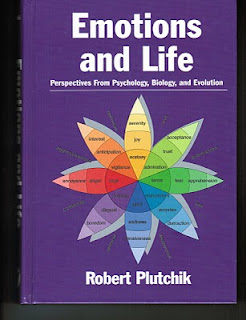
* A book I'm currently reading and which is giving me some background information is Emotions and Life: Perspectives From Psychology, Biology and Evolution by Robert Plutchik (2002). This reads as a college textbook summarizing many theories and perspectives and research. I like the cover:
* Another source I've found useful in helping me identify the breadth of my emotional feelings is the List of Emotions at Wikipedia specifically, the "Emotions by Groups" section ("... tree structured list of emotions as described in Parrot (2001)" ) . Notice that "tension" is the tertiary feeling of "fear".
If you haven't read My Journey to Feeling: Part 1 you may want to start with that before continuing here.
* The word "emotion" includes the word "emote" which (per Merriam-Webster online) means "to give expression to emotion especially in acting". We can say that emotion implies action. For example, the action associated with fear is fight or flight.
* In the same way that your feelings interpret your environment, you also send out 'vibes' or emotional signals to others.
* We humans don't have claws, beaks, fangs, venomous stingers, horns or antlers. We're pretty helpless when we're alone. However, in a group we "kick butt". Emotion sense-feeling is the pre-verbal group language.
* If you dampen a feeling, you also dampen the outbound signal to others. If others don't respond to you emotionally it could be because you're not giving them anything to respond to.
* If you have trouble identify feelings, a good friend or therapist who is attuned to hearing verbal cues or "emotional words" can help you identify your core feelings. In these examples, the base emotion is fear. Although the person may not explicitly report feeling afraid, the underlying emotion may be verbally revealed, for example:
- I'm afraid what she'll say if I...
- I'm scared of what will happen if I...
- I'm afraid of you because...
- etc...
(Sometimes in Wujifa Zhan Zhuang class, I'll be receiving an adjustment to my structure/posture and this will take me to the edge of an emotional reaction and I'll choke back and not express that emotion. Just too scary to let it go... I wonder how zhan zhuang would feel to me if I weren't holding so much... ? )* Imagine living in a state of constant vigilance to keep the damper on. It must be like being on guard duty 24x7 without ever getting some R&R. Must be very tiring.
* How much of your posture is an embodiment of emotional cowering? How would your posture, your structure change if you were to allow the free expression of all emotions, not damper emotions, not holding?
* If you feel free, relaxed, and emotionally open in one situation but not another, it may be that the perceived threat is removed. However, the internal pattern persists. It is that emotional neuro-muscular patterning that is the focus of changing. What is the threat level? Is it even real? Is it a "ghost" from the past irrelevant to the present?
* Every time you get into a situation where you feel yourself dampening the feeling, simply tell yourself, "I am afraid." Doing so "puts it on the radar", so to speak. It elevates the pre-conscious, pre-verbal feeling into verbal consciousness. It helps makes the feeling noticeable and so it becomes track-able over time.
* A book I'm currently reading and which is giving me some background information is Emotions and Life: Perspectives From Psychology, Biology and Evolution by Robert Plutchik (2002). This reads as a college textbook summarizing many theories and perspectives and research. I like the cover:

* Another source I've found useful in helping me identify the breadth of my emotional feelings is the List of Emotions at Wikipedia specifically, the "Emotions by Groups" section ("... tree structured list of emotions as described in Parrot (2001)" ) . Notice that "tension" is the tertiary feeling of "fear".
Friday, March 25, 2011
My Journey to Feeling: Part 3
Feeling the ever increasing subtleties of kinesthetic feeling, the internal connectedness in Wujifa zhan zhuang also requires a journey into feeling the depth and breadth of emotional feeling.
If you haven't read My Journey to Feeling: Part 2 you may want to read that before continuing here.
* Non-articulated verbal responses (internal monologue) to an event is not a feeling. What is the feeling under this?
* The body is constantly taking in and processing stimuli. However, there is too much to analyze rationally so feeling provides a slice of reality, a compressed summary, a use-able message.
* Process is something like: Perception, Feeling, Response, Thought.
* Feeling can be influenced by beliefs and memory. A belief system can dampen feeling, for example, it's bad or wrong to express feelings of anger, lust, or whatever feeling...
* There are no good or bad, right or wrong feelings. Judgment is born of thought. Feeling is always pre-thought, pre-verbal.
* Fantasy keeps you "safe" in terms of, it acts like a pressure relief valve. Engaging in fantasy creates an internal event that fools the body and reduces the pressure. However, it does not promote a functional integration of feeling, thought and action.
* To the extent that you dampen one feeling is the extent to which you dampen all feeling. For example, dampen anger or sadness and you unwittingly dampen joy and compassion. If you dampen your ability to feel emotions, then you also dampen your ability to feel kinesthetically.
* What are you afraid of? What are you avoiding? For me, right now, I'm afraid of and avoid emotionally charged conflicts. I avoid feeling overwhelmed by feeling.
* How do you dampen feeling? I load it into my shoulders - I feel my shoulders tensing and tingling. I give myself "heart-burn". I clench my jaw and grrrrr.
* Find a list of feeling or emotion words. Identify and distinguish your different feelings. Become familiar with your range of feelings.
* You can allow a fullness of feeling and choose to not act. Simply notice "Ah. This is how anger feels. This is how sadness feels. This is how lust feels. etc..." Sit with the feeling. Notice how the feeling feels as it moves through your body. Connect. What do you notice?
* Don't fall into the trap of "I think I should feel..." whatever in a given situation. Simply notice.
If you haven't read My Journey to Feeling: Part 2 you may want to read that before continuing here.
* Non-articulated verbal responses (internal monologue) to an event is not a feeling. What is the feeling under this?
* The body is constantly taking in and processing stimuli. However, there is too much to analyze rationally so feeling provides a slice of reality, a compressed summary, a use-able message.
* Process is something like: Perception, Feeling, Response, Thought.
* Feeling can be influenced by beliefs and memory. A belief system can dampen feeling, for example, it's bad or wrong to express feelings of anger, lust, or whatever feeling...
* There are no good or bad, right or wrong feelings. Judgment is born of thought. Feeling is always pre-thought, pre-verbal.
* Fantasy keeps you "safe" in terms of, it acts like a pressure relief valve. Engaging in fantasy creates an internal event that fools the body and reduces the pressure. However, it does not promote a functional integration of feeling, thought and action.
* To the extent that you dampen one feeling is the extent to which you dampen all feeling. For example, dampen anger or sadness and you unwittingly dampen joy and compassion. If you dampen your ability to feel emotions, then you also dampen your ability to feel kinesthetically.
(Within the last month of this writing, I had an experience at Wujifa class which crystallized this for me. I'm thinking now that I've reached a plateau in what I can feel kinesthetically because I have the damper on feeling emotionally. I've got to work on developing my ability to feel emotionally to continue making progress feeling kinesthetically. Everything is connected!)* Notice your rules governing expressing feelings.
* What are you afraid of? What are you avoiding? For me, right now, I'm afraid of and avoid emotionally charged conflicts. I avoid feeling overwhelmed by feeling.
* How do you dampen feeling? I load it into my shoulders - I feel my shoulders tensing and tingling. I give myself "heart-burn". I clench my jaw and grrrrr.
(Notice that these are all pre-verbal, pre-thought bodily responses to a feeling that were possibly developed in and shaped by earlier situations which over time may have become beliefs which now unconsciously control my kinesthetic reaction. Noticing a meta-process loop?)* So... when a feeling arises, practice just "being" with the feeling. Try to not judge. Try to not dampen. Try to not express. Simply sit with the feeling. Notice and feel.
* Find a list of feeling or emotion words. Identify and distinguish your different feelings. Become familiar with your range of feelings.
* You can allow a fullness of feeling and choose to not act. Simply notice "Ah. This is how anger feels. This is how sadness feels. This is how lust feels. etc..." Sit with the feeling. Notice how the feeling feels as it moves through your body. Connect. What do you notice?
* Don't fall into the trap of "I think I should feel..." whatever in a given situation. Simply notice.
Friday, March 18, 2011
My Journey to Feeling: Part 2
Feeling the ever increasing subtleties of kinesthetic feeling, the internal connectedness in Wujifa zhan zhuang also requires a journey into feeling the depth and breadth of emotional feeling.
If you haven't read My Journey to Feeling: Part 1 read that before continuing here.
Most people are neither "up" nor "down" but in a kind of "neutral" emotional space.
I've noticed that my "neutral" space is more a kind of numbness as if there were no undercurrent of the joy of living, curiosity, playfulness, enthusiasm. Daily life is more like mechanically going through the motions of living; like a kind of emotional zombie.
Question: How do I feel what is under this "numbness"?
Numbness is a form of depression. People can't walk around everyday being sad, or angry, or fearful, or lonely, or whatever so they numb themselves, damper, mute the feeling. However, damping or muting feeling cannot be selectively applied to particular feelings. Damping affects all feelings, like the damper pedal on the piano, it dampens the entire keyboard.
Sometimes people numb themselves to "soldier through" a particular situation but then get stuck there. They fulfill their duty or responsibility but then lose their response-ability, their ability to respond.
For some people, the underlying emotion is fear. What are you afraid of? What are you avoiding?
Coming out of numbness can be dangerous in that you don't know how to handle all the feelings you are now no longer numb to. It's like coming out of a dark movie theater into the afternoon sun and you cringe and shield your eyes until they adjust.
Taking the damper off may drop you into a swamp. Feelings can be messy. A lot of people don't want to go into the swamp. Going through your swamp is your gong-fu.
The good news is that you don't need to make what are considered big, life altering changes. A change of one degree (of the 360 on a compass) today can result in a huge change over time. Baby steps also feel safer and can be easier to implement.
Look at the past, not for a magical "a-ha" solution to today's concern, but rather for a time when the damper was off. Also, to reveal any early patterns that got embedded and may be influencing choices today.
Notice when and more importantly how you mute or dampen feeling. Use the "when" to notice the "how".
If you haven't read My Journey to Feeling: Part 1 read that before continuing here.
Most people are neither "up" nor "down" but in a kind of "neutral" emotional space.
I've noticed that my "neutral" space is more a kind of numbness as if there were no undercurrent of the joy of living, curiosity, playfulness, enthusiasm. Daily life is more like mechanically going through the motions of living; like a kind of emotional zombie.
Question: How do I feel what is under this "numbness"?
Numbness is a form of depression. People can't walk around everyday being sad, or angry, or fearful, or lonely, or whatever so they numb themselves, damper, mute the feeling. However, damping or muting feeling cannot be selectively applied to particular feelings. Damping affects all feelings, like the damper pedal on the piano, it dampens the entire keyboard.
Sometimes people numb themselves to "soldier through" a particular situation but then get stuck there. They fulfill their duty or responsibility but then lose their response-ability, their ability to respond.
For some people, the underlying emotion is fear. What are you afraid of? What are you avoiding?
Coming out of numbness can be dangerous in that you don't know how to handle all the feelings you are now no longer numb to. It's like coming out of a dark movie theater into the afternoon sun and you cringe and shield your eyes until they adjust.
Taking the damper off may drop you into a swamp. Feelings can be messy. A lot of people don't want to go into the swamp. Going through your swamp is your gong-fu.
The good news is that you don't need to make what are considered big, life altering changes. A change of one degree (of the 360 on a compass) today can result in a huge change over time. Baby steps also feel safer and can be easier to implement.
Look at the past, not for a magical "a-ha" solution to today's concern, but rather for a time when the damper was off. Also, to reveal any early patterns that got embedded and may be influencing choices today.
Notice when and more importantly how you mute or dampen feeling. Use the "when" to notice the "how".
Friday, March 11, 2011
My Journey to Feeling: Part 1
Developing the ability to feel is a journey.
Sure, I can "feel". I have the sensory perception of touch. My tongue can distinguish flavors. My ear can hear a variety of pitches, timbres and volumes. I can feel emotions. So what's the problem? After all these years, why do I still have trouble feeling deeper and ever more subtle layers of my "internal" kinesthetics which is needed to develop the internal strength of Taiji, Ba-gua, and Xing-yi? Feeling is feeling is feeling after all, right?
Somewhere in my life, I came to value others' feelings over mine especially when my feelings conflicted with others' feelings. In those cases, I would de-value and block expressing my feelings and rationalize a "good reason" for doing so.
I recently discovered that my efforts in developing kinesthetic feeling in Wujifa Zhan Zhuang conflicted with my lifelong habit of stifling my emotional feeling as I just described. As a result, I was trying to grow feeling AND at the same time, I was trying to squash feeling. I was trying to light the candle and extinguish the candle at the same time.
Years ago I tried an exercise: Check in with yourself periodically throughout the day and notice what you're feeling. When I tried this, I mostly noticed that I felt nothing and so I gave up on the exercise.
Recently, I've picked this up again. But in the interim, I learned that I cannot ever not be feeling. Me, "my" body is a sensory organ. There is no fundamental disconnect between my "head" and my "heart". The connection is there. (It's called the nervous system.) Physiological processes encounter or react to external or internal stimuli and create "feelings". Feeling is primary. Rationale thought and interpretation of feeling is secondary.
And if there is ever a time when there appears to be no "emotional" feeling, then notice a physical feeling. Is the chair hard or soft? Are your eyes sore from reading too much? and on and on... There is always feeling.
So in trying this exercise now, I'm completely blown away each time I "check in" because I notice that I'm feeling! I don't need a label for the feeling. I simply notice a feeling. And here's an "Ah-ha!" moment... maybe where I got stuck before was thinking that if I couldn't label a feeling, then it didn't exist. So not true! The feeling existed. The label did not. Two very different experiences!
Developing a new habit of simply noticing feeling in all its variety is a journey that can begin with simple, baby steps like the exercise described above.
Continues with: My Journey to Feeling: Part 2
Sure, I can "feel". I have the sensory perception of touch. My tongue can distinguish flavors. My ear can hear a variety of pitches, timbres and volumes. I can feel emotions. So what's the problem? After all these years, why do I still have trouble feeling deeper and ever more subtle layers of my "internal" kinesthetics which is needed to develop the internal strength of Taiji, Ba-gua, and Xing-yi? Feeling is feeling is feeling after all, right?
Somewhere in my life, I came to value others' feelings over mine especially when my feelings conflicted with others' feelings. In those cases, I would de-value and block expressing my feelings and rationalize a "good reason" for doing so.
I recently discovered that my efforts in developing kinesthetic feeling in Wujifa Zhan Zhuang conflicted with my lifelong habit of stifling my emotional feeling as I just described. As a result, I was trying to grow feeling AND at the same time, I was trying to squash feeling. I was trying to light the candle and extinguish the candle at the same time.
Years ago I tried an exercise: Check in with yourself periodically throughout the day and notice what you're feeling. When I tried this, I mostly noticed that I felt nothing and so I gave up on the exercise.
Recently, I've picked this up again. But in the interim, I learned that I cannot ever not be feeling. Me, "my" body is a sensory organ. There is no fundamental disconnect between my "head" and my "heart". The connection is there. (It's called the nervous system.) Physiological processes encounter or react to external or internal stimuli and create "feelings". Feeling is primary. Rationale thought and interpretation of feeling is secondary.
And if there is ever a time when there appears to be no "emotional" feeling, then notice a physical feeling. Is the chair hard or soft? Are your eyes sore from reading too much? and on and on... There is always feeling.
So in trying this exercise now, I'm completely blown away each time I "check in" because I notice that I'm feeling! I don't need a label for the feeling. I simply notice a feeling. And here's an "Ah-ha!" moment... maybe where I got stuck before was thinking that if I couldn't label a feeling, then it didn't exist. So not true! The feeling existed. The label did not. Two very different experiences!
Developing a new habit of simply noticing feeling in all its variety is a journey that can begin with simple, baby steps like the exercise described above.
Continues with: My Journey to Feeling: Part 2
Thursday, December 9, 2010
Mastering Internal Strength
One of my recurring questions used to be, "How long it take to 'get' internal strength?" which of course is a different question from, "How long does it take to 'master' internal strength?"
When I returned to the School of Cultivation and Practice after my three year hiatus, I noticed that one of my new and younger school brothers developed a basic level of internal strength with about three years of practicing stance and other specific mind-body exercises. (He started after I left.) I understand that he practiced more than three hours a day with attending class and private practice time!
How is it that he 'got something' with three years of practice and I didn't 'get anything' with my previous twenty years of practice?
In the 2008 book, Outliers: The Story of Success by Malcolm Gladwell, Part 1, Chapter 2 is titled "The 10,000 Hour Rule" in which he reframes the old "nature vs. nurture" argument into "talent vs. practice" or "talent vs. preparation". He says,
Well, one aspect is time. Time spent practicing. Here are a few ways I can analyze my practice schedule regarding how long it may take me to develop or master internal strength:
1 hour/day x 7 days/week x 365 days/year = 365 hours a year.
So, 10,000/365 = 27 years.
2 hours/day x 7 days/week x 365 days/year = 730 hours a year.
So, 10,000/730 = 14 years.
3 hours/day x 7 days/week x 365 days/year = 1095 hours a year.
So, 10,000/1095 = 9 years.
Well, I've logged my 10,000 hours but apparently time alone is not a predictor of mastery. So again, what are the "circumstances and opportunities" that I missed and that maybe I can still look for?
Also in the "The 10,000 Hour Rule" chapter, Gladwell references Dr. K. Anders Ericsson's early 1990's study. So, I looked into Dr. Ericsson and found...
Dr. K. Anders Ericsson... is widely recognized as one of the world's leading theoretical and experimental researchers on expertise. Dr Ericsson's research interests and publications can be found (as of this posting) at the Florida State University, Department of Psychology.
I've never heard of expertise studies. (Maybe developing and mastering internal strength can be approached from the view of expertise studies?) So I looked around some more and found various books have referenced Dr. Ericsson's and others' expertise studies, for example:
This Is Your Brain on Music: The Science of a Human Obsession by Daniel J. Levitin 2006. Chapter 7 is titled "What Makes a Musician? Expertise Dissected.
After I read this, I had a little "a-ha" moment. The "Characteristics of Deliberate Practice" seems to be a very functional approach to developing mastery which in my view can be equally applied to mastering internal strength:
If I reword or reframe the above into what I might look for in terms of the teaching methods of someone teaching skills that can lead to internal strength, I might say the teacher would...
In conclusion, in my opinion, one of the contributions of Wujifa to the internal martial arts community is that it uses "Characteristics of Deliberate Practice". I've seen how practicing Wujifa can lead to developing internal strength in as little as three years. For myself, I've made a lot of progress in this system since returning to class seven years ago!
When I returned to the School of Cultivation and Practice after my three year hiatus, I noticed that one of my new and younger school brothers developed a basic level of internal strength with about three years of practicing stance and other specific mind-body exercises. (He started after I left.) I understand that he practiced more than three hours a day with attending class and private practice time!
How is it that he 'got something' with three years of practice and I didn't 'get anything' with my previous twenty years of practice?
In the 2008 book, Outliers: The Story of Success by Malcolm Gladwell, Part 1, Chapter 2 is titled "The 10,000 Hour Rule" in which he reframes the old "nature vs. nurture" argument into "talent vs. practice" or "talent vs. preparation". He says,
"Success is not a random act. It arises out of a predictable and powerful set of circumstances and opportunities." (pg. 155)So the question I have is: What are the "predictable and powerful set of circumstances and opportunities" that I can access to develop and master internal strength?
Well, one aspect is time. Time spent practicing. Here are a few ways I can analyze my practice schedule regarding how long it may take me to develop or master internal strength:
1 hour/day x 7 days/week x 365 days/year = 365 hours a year.
So, 10,000/365 = 27 years.
2 hours/day x 7 days/week x 365 days/year = 730 hours a year.
So, 10,000/730 = 14 years.
3 hours/day x 7 days/week x 365 days/year = 1095 hours a year.
So, 10,000/1095 = 9 years.
Well, I've logged my 10,000 hours but apparently time alone is not a predictor of mastery. So again, what are the "circumstances and opportunities" that I missed and that maybe I can still look for?
Also in the "The 10,000 Hour Rule" chapter, Gladwell references Dr. K. Anders Ericsson's early 1990's study. So, I looked into Dr. Ericsson and found...
Dr. K. Anders Ericsson... is widely recognized as one of the world's leading theoretical and experimental researchers on expertise. Dr Ericsson's research interests and publications can be found (as of this posting) at the Florida State University, Department of Psychology.
I've never heard of expertise studies. (Maybe developing and mastering internal strength can be approached from the view of expertise studies?) So I looked around some more and found various books have referenced Dr. Ericsson's and others' expertise studies, for example:
This Is Your Brain on Music: The Science of a Human Obsession by Daniel J. Levitin 2006. Chapter 7 is titled "What Makes a Musician? Expertise Dissected.
"The ten thousand-hours theory is consistent with what we know about how the brain learns. Learning requires the assimilation and consolidation of information in the neural tissue. The more experiences we have with something, the stronger the memory/learning trace for that that experience becomes. Although people differ in how long it takes them to consolidate information neurally, it remains true that increased practice leads to greater number of neural traces, which can combine to create a stronger memory representation. ... The strength of a memory is related to how many times the original stimulus has been experienced. " (pg 193)(Maybe mastering internal strength has to do with repeating specific experiences 10,000 hours ?) So I did a little more digging and I found what I'm guessing is "the early 1990's" Ericsson article referenced in the above books:
The Role of Deliberate Practice in the Acquisition of Expert Performance (available as pdf)Here are a few excerpts:
K. Anders Ericsson, Ralf Th. Krampe, and Clemens Tesch-Romer
Psychological Review
1993, Vol. 100. No. 3, 363-406
We have shown that expert performance is acquired slowly over a very long time as a result of practice and that the highest levels of performance and achievement appear to require at least around 10 years of intense prior preparation.
Characteristics of Deliberate Practice
The most cited condition concerns the subjects' motivation to attend to the task and exert effort to improve their performance. In addition, the design of the task should take into account the preexisting knowledge of the learners so that the task can be correctly understood after a brief period of instruction. The subjects should receive immediate informative feedback and knowledge of results of their performance. The subjects should repeatedly perform the same or similar tasks.
Comparison of Deliberate Practice to Other Types of Domain-Related Activities
Deliberate practice includes activities that have been specially designed to improve the current level of performance.
Conclusion
The commitment to deliberate practice distinguishes the expert performer from the vast majority of children and adults who seem to have remarkable difficulty meeting the much lower demands on practice in schools, adult education, and in physical exercise programs.
After I read this, I had a little "a-ha" moment. The "Characteristics of Deliberate Practice" seems to be a very functional approach to developing mastery which in my view can be equally applied to mastering internal strength:
- The subject's motivation to attend to the task and exert effort to improve their performance.
- the design of the task should take into account the preexisting knowledge of the learners
- the task can be correctly understood after a brief period of instruction.
- The subjects should receive immediate informative feedback and knowledge of results of their performance.
- The subjects should repeatedly perform the same or similar tasks.
If I reword or reframe the above into what I might look for in terms of the teaching methods of someone teaching skills that can lead to internal strength, I might say the teacher would...
- Design, teach and use simple, elemental tasks that "fit" the preexisting knowledge of the learners. (For me this means talking to me in my vernacular, in my "western" paradigm and not forcing me for example, into the Chi paradigm.)
- Design, teach and use simple, elemental tasks that can be correctly understood after a brief period of instruction. (For example, the Wujifa Alignment, 1,2,3,4 - 1,2,3,4.)
- Design, teach and use simple, elemental tasks that provide immediate feedback. (For example: feeling the burning in the quadriceps or focus on feeling connectedness and noticing gaps in feeling.)
- Design, teach and use simple, elemental tasks that can be performed repeatedly. (To me, this does not include forms. Forms are very complex. A simple task that can be performed repeatedly might be something like zhan zhuang, or side-to-side or one of the Wujifa warm-up exercises.)
How can I break down, for example, "Fair Maiden Weaves Shuttle" into a simple, elemental "task" that I can perform repeatedly, that will deliver immediate feedback, that can be quickly and easily understood by another person, and that fits pre-existing knowledge? And I would add, that would lead to deeper levels of feeling of connectedness? Of course, all of this must be validate-able.)According to my understanding of the little I read to write this post, I violated every characteristic of deliberate practice that would lead to expertise in my chosen field - mastering internal strength. So, from this limited perspective, it's no surprise that I wound up where I am. (I'm no expert in expertise studies. I just started connecting some dots and this is my understanding at this time.)
In conclusion, in my opinion, one of the contributions of Wujifa to the internal martial arts community is that it uses "Characteristics of Deliberate Practice". I've seen how practicing Wujifa can lead to developing internal strength in as little as three years. For myself, I've made a lot of progress in this system since returning to class seven years ago!
Tuesday, November 23, 2010
Internal Gong Fu Paradigms
In my years of learning different internal gong fu forms and other practices, I primarily saw and learned the superficial, mechanical differences without deeply understanding the differences in their underlying paradigms.
I tried synthesizing ideas without first having a basic functional understanding of each. As a result, I wound up with a confused stew pot of ideas. I learned to "talk the talk".
My purpose in writing this article is twofold. This is primarily an exercise to help me clarify my understanding of the paradigms of various internal gong fu practices. And in so doing, present you, the reader with my current understanding. Specifically, I want to answer the question, "What's the difference between Wujifa and its paradigm and other internal gong fu practices and their paradigms?"
First, what is a paradigm? The Merriam-Webster Online dictionary defines paradigm as:
Paradigms in the Asian Tradition
Paradigms in the Euro-American Tradition:
Qi-gong - based on the Chi and Fantasy paradigms.
Wu- Ji standing practice - based on the Wu-Ji and Chi paradigms.
Tai-chi chuan - based on the Yin-yang and Chi paradigms. Popularly practiced from the Mechanistic paradigm and employing the Fantasy and sometimes Mystical paradigm.
Ba-gua chuan - based on the Ba-gua and Chi paradigms.
Xing-yi chuan - based on the Five Element or Twelve Animal and Chi paradigms.
Wujifa - based on the Functional paradigm. The School of Cultivation and Practice uses a functional definition of Wu-Ji and approaches Wu-Ji functionally looking for connectedness.
What's interesting is that I've been going to classes for years (decades), and I will come home and practice the methods and never really see the big picture of the school I was and am attending. Writing this article has been a great experience in helping me see the differences in the philosophies driving the practices.
I tried synthesizing ideas without first having a basic functional understanding of each. As a result, I wound up with a confused stew pot of ideas. I learned to "talk the talk".
My purpose in writing this article is twofold. This is primarily an exercise to help me clarify my understanding of the paradigms of various internal gong fu practices. And in so doing, present you, the reader with my current understanding. Specifically, I want to answer the question, "What's the difference between Wujifa and its paradigm and other internal gong fu practices and their paradigms?"
First, what is a paradigm? The Merriam-Webster Online dictionary defines paradigm as:
"a philosophical and theoretical framework of a scientific school or discipline within which theories, laws, and generalizations and the experiments performed in support of them are formulated; broadly : a philosophical or theoretical framework of any kind"Here's my current understanding of the paradigms of the various practices from my experience.
Paradigms in the Asian Tradition
- Chi or Qi ( 气 ; qì ) paradigm: An invisible energy is the foundation of the universe. This energy flows through humans via a meridian system. Learning how to recognize and direct one's energy (internally) can also open one to connecting with the energy of nature and the universe.
[Over the years, I've done all kinds of Qi-gong exercises with a variety of teachers in a variety of settings and heard Chi explained all kinds of way including doing Tai-chi as a moving qi-gong. So my 'definition' is kind of the gist of everything I've heard or read.]
(The below are listed as "sub-paradigms" as I believe the chi-paradigm runs through each.)
- Wu-Ji ( 无 极 ; wú jí ) paradigm: the mother, the undefined that gives birth from the flow of energy of the Tao to Yin-yang, Five Elements and the ten thousand things. The stillness underlying movement.
[When I got to college, I pursued a Bachelors in Religious Studies and Philosophy focusing on Asian Buddhism and Taoism. So of course, being on a college campus on Long Island, NY in the 1980s, and with New York City just a train ride away, I tasted A LOT of fruit. Transcendental Meditation, staring at a candle flame tip, staring at a full moon, sitting in a tree feeling how the tree grounds the wind, attending the Church of Eclectic Esoteric Whatever and on and on. Looking back, when I started, I remember sitting and notice my mind racing everywhere. Crazy. I can get to a quiet place much easier now.]
- Yin-yang ( 阴 阳 ; yīn yáng) paradigm: A philosophy of duality, polarity; complimentary opposites in balance.
[In the 1980's, in addition to usual classes, I also attended workshops and seminars with William C.C. Chen, T.T. Liang, Yang, Jwing-ming and many others I've forgotten at summer camps at the original Tai chi Farm. So looking at Tai-chi, first there is the full leg/empty leg thing. And then in push-hands, where an opponent presents strength, I yield; where an opponent is weak, I fill with strength. I understand and feel this at the mechanical level, however, I never got to the point of consciously applying this paradigm in my daily life.]- Five Element ( 五行 ; wǔ xíng) paradigm: A philosophy recognizing five fundamental forces and how each overcomes or gives rise to the next.
[I attended a couple seminars on the Five Element Xing-yi. One with Yan, Gao-fei and one with Gary Torres. In Yan's seminar, I remember spending a lot of time on practicing and honing the feel of the form and less time on philosophy. In Gary's seminar, I remember him covering a some philosophy and then we got into doing a two person Five Element Xing-Yi fighting form where for example, I attack with Wood and my opponent counters with Metal. Gary also covered the acu-point striking with Xing-Yi and how rubbing or slapping one point can overcome the effects of another being struck. So even in the acu-point area, I got a taste of the Five Element philosophy.]
- Ba-Gua ( 八 卦 ; bā guà) paradigm: A philosophy recognizing eight fundamental principles of reality. Associated with the I-Ching.
[This is probably the sparsest of my "internal" form training. I took a set of classes with Victor Chao and learned some forms and some philosophy. I never got anywhere near learning all his 64 forms. So it's hard for me to say much about Ba-Gua. My experience is pretty limited here.]
- Twelve Earthly Branches ( 干 支 ; gān zhī) or the Twelve Animal Zodiac ( 生 肖 ; shēng xiào) paradigm: Each of the twelve animals of the zodiac express particular characteristics.
[This is the wildest stuff. When I trained with Bob Klein at the Long Island School of Tai Chi Chuan in the 1980's, there was a strong emphasis on nature and wild animals. (You might recognize me in a few of the videos he made during at that time.) I learned a Tai-chi Monkey and Mantis form and started learning a Snake form but never got through it. When I was learning the monkey form, I used to go to the Bronx Zoo early Saturday mornings and sit for hours in the primate house watching the chimpanzees. Bob, being a zoologist would also on occasion bring out his boa constrictors. Very cool! So I got a chance to handle some very large snakes as well as do some snake staring. The purpose of all this training was to imbue my animal forms with the "spirit" of that animal. I also got to where I could imitate squirrels (in abundance in the local woods) but I got pretty jittery and so stopped this animal. Some wild stuff!]
- I-Ching paradigm: An ambiguous framework of eight trigram/sixty four hexagrams meant to explain how things work through correlation.
[You know, again, lots of different teachers have spoken of the I-Ching and somehow tied it back to Chinese martial arts but I still personally don't see how this is an underlying paradigm for any internal gong fu form or practice. Maybe one day, but for now, I just don't understand.]
Paradigms in the Euro-American Tradition:
- Mechanistic paradigm: The philosophy of DeCartes and Newton. "I think therefore I am." Head-Body duality. Tends to not feel or to strictly control feeling of intuitions and emotions. Lives life by rigid formulas, laws, rules, codes of behavior.
[This is the paradigm I grew up with so this thing is deep in my bones and influences every activity and thought and relationship and, and, and,.... When it came to learning martial arts, this is the place I came from. And when I could reproduce the mechanics of forms, techniques and applications, well, I thought that was the pinnacle. And why not, I also attend and even participated in a couple competitions (back in my Long Island days) and to me, then, competitions were all about being judged on mechanics. So... ]
- Fantasy paradigm: A philosophy that the use of imagery and concepts will evoke bodily sensations. However, people often get lost in the image and don't develop validate-able skills.
[Wow! Who hasn't heard these lines before? Imagine hanging from a string. Imagine roots growing out the bottom of your feet. Imagine moving as if through a thick viscous fluid. Imagine a ball of white energy between your hands. etc..]
- Mystical or Spiritual paradigm: A philosophy of garnering power through petitioning or connecting with a "higher power" or supernatural being beyond my comprehension. Again, people often get lost in the "woo-woo" and don't develop validate-able skills.
[Again, my whole Bachelors degree was about this stuff. However, I approached my studies mechanically, not understanding my philosophy nor experimenting with living the philosophies I was studying. As an extra-curricular assignment, I attended a wide range of different churches, synagogues, and temples, sweat lodges etc. over four years. It was interesting. Where I confused myself was in associating any of this wide variety of religious and spiritual practices with Tai-chi or Qi-gong.]
- Functional paradigm: Looks to generalize principles found in natural, scientific and various other processes. Not based on rules or methods. See my article "Functionality and Wujifa".
[When I started practicing Wujifa I was struck by the lack of forms, by the focus on feeling, by the focus on using temporary methods as short-term "medicine" to yield a particular result, namely a feeling of more connectedness, to work through a "sticky-point". Philosophically, the "Wu-Ji" of Wujifa is the same as the Wu-Ji above, loosely translated as No Ridge Pole, No dead post. The "Fa" of Wujifa refers to principle, law, or method. And it is this "Fa" that distinguishes the Wujifa standing practice from the common Wuji standing practice. So altogether, Wujifa is the way or principle of not being a dead post - or being fully alive, of being functional. This is kind of how I'm understanding it now.]
Qi-gong - based on the Chi and Fantasy paradigms.
Wu- Ji standing practice - based on the Wu-Ji and Chi paradigms.
Tai-chi chuan - based on the Yin-yang and Chi paradigms. Popularly practiced from the Mechanistic paradigm and employing the Fantasy and sometimes Mystical paradigm.
Ba-gua chuan - based on the Ba-gua and Chi paradigms.
Xing-yi chuan - based on the Five Element or Twelve Animal and Chi paradigms.
Wujifa - based on the Functional paradigm. The School of Cultivation and Practice uses a functional definition of Wu-Ji and approaches Wu-Ji functionally looking for connectedness.
* * * * *
I hope my sharing gives you an idea of my cumulative knowledge of my experiences with various martial arts and internal gong fu practices and my current understanding of Wujifa as I practice it today.What's interesting is that I've been going to classes for years (decades), and I will come home and practice the methods and never really see the big picture of the school I was and am attending. Writing this article has been a great experience in helping me see the differences in the philosophies driving the practices.
Thursday, September 9, 2010
Why Relax?
I have heard "Relax. Calm down. Let go." more often than I can remember. And I dutifully engage my concept of relax to the level I'm capable. But why relax? What's the purpose of relax?
Last night, while standing at my kitchen sink washing vegetables, my mind somehow turned to this question and some answers "just occurred to me". (See Framing Your Zhan Zhuang Practice about asking questions.) Here's the ideas I was tossing around...
At one level, there is the physiological knowledge that too much stress and tension constricts blood flow, pinches nerves, and is generally not good while relaxing allows more free flow and in turn, better health.
At an internal martial art level, one purpose of relax is to allow the weight to be more fully carried in the legs, creating a more stable structure. See Tai chi - Bottom Heavy, Top Light.
And then the insight I had was that as I go deeper into focusing internally on relaxing my musculature, what I'm actually doing is integrating more and more of my mind into my body which yields a different result than "just" relaxing. This led me to the idea that relax can be more than a result. Relax can also be a method.
Then I recalled, "The method is not the truth. Once you get the feeling, get rid of the method." So I wondered, if relax can be a method, and the method is not the truth, then what is the resultant feeling? Maybe relax is the finger pointing at the moon and not the moon itself.
At one level, relax remains a feeling to compare to tense or less relaxed. For example, "My lower back feels more relaxed now."
At another level, and what occurred to me is, the resultant feeling feels more... something. More mind-full? More integrated? More in-my-body feeling? I don't know what words to use to describe this kinesthetic feeling.
And then I thought about the apparent contradiction that relaxing leads to internal strength.
If I frame relax as a limp, mind-less, noodly feeling, then I don't see how this relax leads to internal strength.
But if I frame relax as a method which integrates mind and body and allows the possibility of developing body-mind-full-ness, then maybe there's no contradiction after all. Why relax? Because maybe relax (the method and the feeling) is a key to a door. But how this integration results in such sturdiness is still a mystery to me.
Does this make any sense? How would you describe your experience or practice with relax?
Last night, while standing at my kitchen sink washing vegetables, my mind somehow turned to this question and some answers "just occurred to me". (See Framing Your Zhan Zhuang Practice about asking questions.) Here's the ideas I was tossing around...
At one level, there is the physiological knowledge that too much stress and tension constricts blood flow, pinches nerves, and is generally not good while relaxing allows more free flow and in turn, better health.
At an internal martial art level, one purpose of relax is to allow the weight to be more fully carried in the legs, creating a more stable structure. See Tai chi - Bottom Heavy, Top Light.
And then the insight I had was that as I go deeper into focusing internally on relaxing my musculature, what I'm actually doing is integrating more and more of my mind into my body which yields a different result than "just" relaxing. This led me to the idea that relax can be more than a result. Relax can also be a method.
Then I recalled, "The method is not the truth. Once you get the feeling, get rid of the method." So I wondered, if relax can be a method, and the method is not the truth, then what is the resultant feeling? Maybe relax is the finger pointing at the moon and not the moon itself.
At one level, relax remains a feeling to compare to tense or less relaxed. For example, "My lower back feels more relaxed now."
At another level, and what occurred to me is, the resultant feeling feels more... something. More mind-full? More integrated? More in-my-body feeling? I don't know what words to use to describe this kinesthetic feeling.
And then I thought about the apparent contradiction that relaxing leads to internal strength.
If I frame relax as a limp, mind-less, noodly feeling, then I don't see how this relax leads to internal strength.
But if I frame relax as a method which integrates mind and body and allows the possibility of developing body-mind-full-ness, then maybe there's no contradiction after all. Why relax? Because maybe relax (the method and the feeling) is a key to a door. But how this integration results in such sturdiness is still a mystery to me.
Does this make any sense? How would you describe your experience or practice with relax?
Tuesday, June 22, 2010
Tai Chi Principles: Muscular Quality of Sung
You may think you know the Tai Chi Principle sung (relax) but have you felt how sung is manifested in the musculature?
A few years ago, a group of us from the Wujifa school attended a week-long seminar featuring one of the well-known Tai Chi Grandmasters. Weeks of giving seminars, jetting back and forth across the United States apparently began taking its toll and he requested a massage.
One of my school brothers, who is a certified massage therapist, had what may be the rare opportunity of giving a massage to this well known grandmaster.
Naturally, after the massage session, we were curious: So, what was it like? How did he feel? The gist of his response was something like: His muscles were firm but soft, like I could press all the way to the bone. Didn't feel any tension. It was awesome!
The point of this story for me is that the Tai Chi principle of sung is a palpable muscular quality!
Since most of us will likely never get an opportunity to palpate a grandmaster's musculature, reading descriptions and definitions of sung are probably the closest we will ever get to imagining how this muscular quality might feel.
For example, the Quotations section of Michael Garofalo's page on Song: Loose, Relaxed, Open, Yielding, Free, Responsive. A Defining Mind-Body Characteristic of Taijiquan and Qigong offers a variety of descriptions.
However, I think the Tai Chi Society, description of The Correct Internal Principles of Tai Chi gets to the point without introducing any useless embellishments:
So then, given all this "third-party" data and our own interpretative filters, what then is the most functional way to develop sung? Through working at the kinesthetic level of your musculature; through practicing Zhan Zhuang.
Sung is not an imagined state of mind. Sung is not a belief about oneself. The imagination and belief processes can dis-associate "oneself" from corporeal reality. Therefore, saying or believing: "I am easy-going. I am relaxed." does not necessarily translate into a sung muscular reality. (You may think you are relaxed but your muscles may tell a different story! You can verify this for yourself now.) The bottom line is, sung is a real, tactile, kinesthetic, palpable muscular quality. Sung can be verified at the muscular level.
Based on my experience, many claim to practice an internal martial art, yet they only see and mimic the external representation of forms because they have not developed the skill to see what is going on beneath the skin. (I have been in this camp.)
Just because you think your form looks the same as the grandmaster's (to your untrained eyes), doesn't mean that the way you move is even vaguely "internal", even vaguely similar. When you calibrate to the external because you cannot yet calibrate to the internal, then it's easy to fool yourself into thinking that you are moving the way the master is moving.
Or said another way, if the chronic tensions and structural distortions of your musculature are invisible to you, and you do not manifest sung in your structure, then you will not see sung in the master's structure.
Therefore, rather than learning (faux) Tai Chi or silk reeling or any other "internal" form and claim to be doing Tai Chi or whatever, it would be better to first develop the palpable, muscular quality of sung. Once having sung and connection, then all your forms will have an "internal" quality.
As for me, for all the relaxing I profess to have worked on over the years, my own muscles still have plenty of chronic tension, plenty of hard spots. Comparing my level of sung to the sung of this grandmaster, well, I have a L-O-N-G way to go! I have a lot of muscular holding patterns to let go of!
For further reading: Functionality and Wujifa
A few years ago, a group of us from the Wujifa school attended a week-long seminar featuring one of the well-known Tai Chi Grandmasters. Weeks of giving seminars, jetting back and forth across the United States apparently began taking its toll and he requested a massage.
One of my school brothers, who is a certified massage therapist, had what may be the rare opportunity of giving a massage to this well known grandmaster.
Naturally, after the massage session, we were curious: So, what was it like? How did he feel? The gist of his response was something like: His muscles were firm but soft, like I could press all the way to the bone. Didn't feel any tension. It was awesome!
The point of this story for me is that the Tai Chi principle of sung is a palpable muscular quality!
Since most of us will likely never get an opportunity to palpate a grandmaster's musculature, reading descriptions and definitions of sung are probably the closest we will ever get to imagining how this muscular quality might feel.
For example, the Quotations section of Michael Garofalo's page on Song: Loose, Relaxed, Open, Yielding, Free, Responsive. A Defining Mind-Body Characteristic of Taijiquan and Qigong offers a variety of descriptions.
However, I think the Tai Chi Society, description of The Correct Internal Principles of Tai Chi gets to the point without introducing any useless embellishments:
"Sung (pronounced soong) means to completely relax mentally and physically; releasing any tension in the mind and body. The muscles, tendons and ligaments, the joints in the back, shoulders, neck, hands and legs, and all other body parts such as the chest and belly must be sung."Of course IF you can get your hands on a Tai Chi Grandmaster's body to feel how those muscles feel, THEN you will know sung through your tactile senses and what these descriptions are really talking about.
So then, given all this "third-party" data and our own interpretative filters, what then is the most functional way to develop sung? Through working at the kinesthetic level of your musculature; through practicing Zhan Zhuang.
Sung is not an imagined state of mind. Sung is not a belief about oneself. The imagination and belief processes can dis-associate "oneself" from corporeal reality. Therefore, saying or believing: "I am easy-going. I am relaxed." does not necessarily translate into a sung muscular reality. (You may think you are relaxed but your muscles may tell a different story! You can verify this for yourself now.) The bottom line is, sung is a real, tactile, kinesthetic, palpable muscular quality. Sung can be verified at the muscular level.
Based on my experience, many claim to practice an internal martial art, yet they only see and mimic the external representation of forms because they have not developed the skill to see what is going on beneath the skin. (I have been in this camp.)
Just because you think your form looks the same as the grandmaster's (to your untrained eyes), doesn't mean that the way you move is even vaguely "internal", even vaguely similar. When you calibrate to the external because you cannot yet calibrate to the internal, then it's easy to fool yourself into thinking that you are moving the way the master is moving.
Or said another way, if the chronic tensions and structural distortions of your musculature are invisible to you, and you do not manifest sung in your structure, then you will not see sung in the master's structure.
Therefore, rather than learning (faux) Tai Chi or silk reeling or any other "internal" form and claim to be doing Tai Chi or whatever, it would be better to first develop the palpable, muscular quality of sung. Once having sung and connection, then all your forms will have an "internal" quality.
As for me, for all the relaxing I profess to have worked on over the years, my own muscles still have plenty of chronic tension, plenty of hard spots. Comparing my level of sung to the sung of this grandmaster, well, I have a L-O-N-G way to go! I have a lot of muscular holding patterns to let go of!
For further reading: Functionality and Wujifa
Thursday, May 20, 2010
The Third Feeling
I came to the internal arts with a fair degree of chronic, habitual tension. Let's call this the first feeling. Slowly I learned to un-tense, to relax, to go limp. Let's call this the second feeling. To develop the connection-ness of internal strength, we want to practice the third feeling.
This "third feeling" is not on the continuum between tense and relax, between problem and solution or any other duality, but rather, it is another feeling outside of and distinct from your yin-yang continuum.
I don’t understand.
It is a riddle.
The third feeling is experienced on the edge of my understanding, outside of my catalog of identified internal kinesthetic experiences. Is 'third' another word for ‘new’? Yes and no. Sometimes it is a deepening or opening of a known feeling as opposed to a different feeling on the same continuum level. Sometimes it is a feeling far off the continuum and not related to any other current feeling. It won’t appear if you tend to run match; expect it to be like a known concept or feeling. Yet, I am open. If it is 'like' anything, it is kind of like confusion or uncertainty but which shows up in the body and short-circuits the brain and may induce stance trance as the mind races to categorize the experience and finds no comparison. An example might be the feeling of “peng jing”.

When I first heard about "peng jing" I thought I could create peng jing by using my imagination with muscular tension. This approach allowed me to create a static, repeatable feeling. That kind of peng jing was based on and tied to a method: tension + imagination = peng jing. However, there is another kind of peng jing that I am discovering that is based on connection and is continually evolving and changing and does not involve tension nor imagination.
A problem that some beginners have is that they will read or hear a master's description of peng jing and then think that they too can have peng jing without first having developed themselves to the level the master has. For example, the master says, “Peng is like xxx.”, and the student attempts the “like xxx” and deludes him/herself into thinking “I have peng.” It is best to have a teacher who is not afraid to say “You’re not ready for that yet. Work on this.” It is best to work at the level you are at. What you seek appears naturally after a lot of correct and level-appropriate practice.
One potential stumbling block is that feelings can become methods when you focus on developing "a" particular feeling. Many feelings are simple byproducts of your practice and in the Wujifa system are regarded as sign-posts along the way. Do not set up camp at the sign-post and work on developing that particular feeling. Doing so will get you stuck. For example, I’m recently able to feel expanding-ness. If I think that this expanding-ness feeling IS peng jing, and I focus strictly on developing this feeling, then I am stuck. Getting stuck in a feeling is not third feeling material.
The method can lead you to the door, but the method cannot open the door. The door opening requires something else altogether. Third feeling. When you put a feeling in a box, then it loses its alive-ness, the what-if-ness. The box can be a method, but a boxed feeling, like my earlier false-peng jing, is never the third feeling. A boxed feeling never grows and develops.
Does this make any sense?
Remember The Matrix - There is no spoon scene? There is no "peng jing". Do not try to attain a particular feeling. Practice to develop connection and more and more and....
This "third feeling" is not on the continuum between tense and relax, between problem and solution or any other duality, but rather, it is another feeling outside of and distinct from your yin-yang continuum.
I don’t understand.
It is a riddle.
The third feeling is experienced on the edge of my understanding, outside of my catalog of identified internal kinesthetic experiences. Is 'third' another word for ‘new’? Yes and no. Sometimes it is a deepening or opening of a known feeling as opposed to a different feeling on the same continuum level. Sometimes it is a feeling far off the continuum and not related to any other current feeling. It won’t appear if you tend to run match; expect it to be like a known concept or feeling. Yet, I am open. If it is 'like' anything, it is kind of like confusion or uncertainty but which shows up in the body and short-circuits the brain and may induce stance trance as the mind races to categorize the experience and finds no comparison. An example might be the feeling of “peng jing”.

When I first heard about "peng jing" I thought I could create peng jing by using my imagination with muscular tension. This approach allowed me to create a static, repeatable feeling. That kind of peng jing was based on and tied to a method: tension + imagination = peng jing. However, there is another kind of peng jing that I am discovering that is based on connection and is continually evolving and changing and does not involve tension nor imagination.
A problem that some beginners have is that they will read or hear a master's description of peng jing and then think that they too can have peng jing without first having developed themselves to the level the master has. For example, the master says, “Peng is like xxx.”, and the student attempts the “like xxx” and deludes him/herself into thinking “I have peng.” It is best to have a teacher who is not afraid to say “You’re not ready for that yet. Work on this.” It is best to work at the level you are at. What you seek appears naturally after a lot of correct and level-appropriate practice.
One potential stumbling block is that feelings can become methods when you focus on developing "a" particular feeling. Many feelings are simple byproducts of your practice and in the Wujifa system are regarded as sign-posts along the way. Do not set up camp at the sign-post and work on developing that particular feeling. Doing so will get you stuck. For example, I’m recently able to feel expanding-ness. If I think that this expanding-ness feeling IS peng jing, and I focus strictly on developing this feeling, then I am stuck. Getting stuck in a feeling is not third feeling material.
The method can lead you to the door, but the method cannot open the door. The door opening requires something else altogether. Third feeling. When you put a feeling in a box, then it loses its alive-ness, the what-if-ness. The box can be a method, but a boxed feeling, like my earlier false-peng jing, is never the third feeling. A boxed feeling never grows and develops.
Does this make any sense?
Remember The Matrix - There is no spoon scene? There is no "peng jing". Do not try to attain a particular feeling. Practice to develop connection and more and more and....
Wednesday, February 17, 2010
Wilhelm Reich - An Introduction
I referenced Wilhelm Reich in a previous post, Internal Structure Part 2 - Structural Integration, and others have referenced him and/or his work in their comments on this site. While I learned about Freud and Jung in college psychology class, I never learned about Reich. I found the below biographical segments very informative and so I am re-posting them here.
Man's Right to Know: The Wilhelm Reich Story
(Watch the following videos on YouTube. Playback on other websites has been disabled by the video owner.)
Man's Right to Know: The Wilhelm Reich Story
"This introductory biography about Wilhelm Reich, M.D. was produced by The Wilhelm Reich Infant Trust in 2002 as both the opening exhibit for visitors to the Wilhelm Reich Museum and as an educational tool for wider audiences. It provides a concise overview of Reich's life and work. Comprised of archival photographs and film footage, plus computer animation, this biography is not intended as a substitute for Reich's literature, but rather as an easy-to-understand introduction to Reich's life and to his discovery and investigations of orgone energy. This production also provides a succinct and dramatic account of the Food and Drug Administration’s campaign to destroy Reich's work."
(Watch the following videos on YouTube. Playback on other websites has been disabled by the video owner.)
Watch Part 3 on YouTube.
Playback on other websites has been disabled by the video owner.
Playback on other websites has been disabled by the video owner.
Wednesday, February 10, 2010
Armoring, Cycles and Crossroads
In December I awoke one morning feeling pain in my left deltoid muscle. I thought this odd as there was no recent single injury incident. When it didn't go away after a month, I went to the M.D. who diagnosed rotator cuff tendonosis. As I educate myself about tendonosis it looks like I injured myself, possibly through chronic poor posture; hunching eight hours a day at my deskjob. This was festering for a long time and finally came into consciousness. So what does this have to do with armoring, cycles and crossroads?
Tracing a spiral, going around, I arrive at the same place again. The same but different. The sameness part of the cycle is relaxing, opening and then clamping down, closing off. What is different is that the feeling of kinesthetically opening gets a little stronger each time and it takes a little more energy to block that off each time. Also, this pattern becomes a little more conscious each time.
Since the last post (where I described feeling opening), I've swung to the closing down. Why vacillate like this? Why not simply continue to open, open, open on a straight line trajectory to mastery? This is just who and how I am.
Part of the down-swing was due to feeling anxiety about the loss of range of motion and pain in my shoulder. How could my body let me down like this? Of course, my question represents a compartmentalized and dis-integrated frame.
The choice to open or close (at whatever level of consciousness this happens) represents a crossroads. A fork in the road. Open? Close? Go with "I know" or "They say"? Or continue cycling between the two in an awareness increasing spiral until.... ?
How is all this revealed in my Wujifa Zhan Zhuang practice? I’m standing, relaxing, letting go, releasing, exploring how far relax can go. The back muscles release... ahhhhh... and then,SNAP! Oh! Stop! Clamp down! The breath grabbing muscle spasm across the lower or upper back. And I block the relax. In fear of inducing another bout of crippling lower back pain, I stop exploring and settle for some level of tension near the edge. For now. Until next time.
As I continue building integration and functionality, I wonder, How much longer can compartmentalization, dis-integration, and dis-functionality survive?
Tracing a spiral, going around, I arrive at the same place again. The same but different. The sameness part of the cycle is relaxing, opening and then clamping down, closing off. What is different is that the feeling of kinesthetically opening gets a little stronger each time and it takes a little more energy to block that off each time. Also, this pattern becomes a little more conscious each time.
Since the last post (where I described feeling opening), I've swung to the closing down. Why vacillate like this? Why not simply continue to open, open, open on a straight line trajectory to mastery? This is just who and how I am.
Part of the down-swing was due to feeling anxiety about the loss of range of motion and pain in my shoulder. How could my body let me down like this? Of course, my question represents a compartmentalized and dis-integrated frame.
"Then what do you mean when you say, 'My body is sore today'? Who is the 'I' who is separate from the body and speaks of it as a possession?"Also, I'm becoming aware of how the "I know. They say." manifests not only in my personal life but also how it is revealed in my Wujifa Zhan Zhuang practice where “I know” could mean “opening” and “They say” could mean “closing”. The feeling, the presence, the "I know" arises and bumps into the armor, the fear, the “They say”. (see time point 3:06 - 4:17. John Gault & Wilhelm Reich, Part 15)
The choice to open or close (at whatever level of consciousness this happens) represents a crossroads. A fork in the road. Open? Close? Go with "I know" or "They say"? Or continue cycling between the two in an awareness increasing spiral until.... ?
How is all this revealed in my Wujifa Zhan Zhuang practice? I’m standing, relaxing, letting go, releasing, exploring how far relax can go. The back muscles release... ahhhhh... and then,SNAP! Oh! Stop! Clamp down! The breath grabbing muscle spasm across the lower or upper back. And I block the relax. In fear of inducing another bout of crippling lower back pain, I stop exploring and settle for some level of tension near the edge. For now. Until next time.
As I continue building integration and functionality, I wonder, How much longer can compartmentalization, dis-integration, and dis-functionality survive?
Subscribe to:
Posts (Atom)